

On July 31st, 2026, Texas made Delta-8, Delta-10, and THCA products illegal. What started as legal hemp products—sold in gas stations, convenience stores, and online—became felonies overnight. But here’s what most people don’t realize: the law didn’t appear out of nowhere. It’s based on a Texas Supreme Court decision from May 2026 that fundamentally changed what the state considers a controlled substance. If you own these products, sell them, or use them, you need to understand this law immediately—because the penalties are severe.
Watch the Full Legal Breakdown
The Texas THC Ban — What Changed on July 31st, 2026
The Texas Supreme Court Decision — May 2026 (Texas Department of State Health Services v. Sky Marketing Corp.)
In May 2026, the Texas Supreme Court reversed a previous decision that had protected hemp retailers from state regulation. The case is Texas Department of State Health Services v. Sky Marketing Corp., and it’s critically important because it gave the state the legal authority to ban hemp-derived THC products.
Here’s what happened in plain terms: Back in 2021, hemp retailers won an injunction blocking the Texas Department of State Health Services from banning Delta-8 and other hemp-derived THCs. The retailers argued the state had no authority to regulate these products. They won.
But the Texas Supreme Court reversed that in May 2026. The court said the state health commissioner does have authority to clarify what counts as a controlled substance, even when it’s hemp-derived. That legal authority comes from the 2019 Texas Farm Bill (HB 1325), which legalized hemp—but with one critical condition.
The 2019 Farm Bill Framework — The 0.3% Delta-9 Standard
Texas HB 1325 (2019 Farm Bill) legalized hemp with delta-9 THC up to 0.3% by dry weight. This is the key: hemp is only hemp if it stays under that 0.3% threshold. Everything above 0.3% delta-9 THC is not hemp anymore—it’s a controlled substance under Texas law.
Here’s where most people get confused: Delta-8, Delta-10, and THCA flowers test above the 0.3% delta-9 threshold when lab-tested. Or, they contain other forms of THC that don’t fit the hemp definition. Therefore, they don’t qualify as legal hemp under HB 1325. They’re controlled substances. And as of July 31st, 2026, possession of controlled substances is a felony.
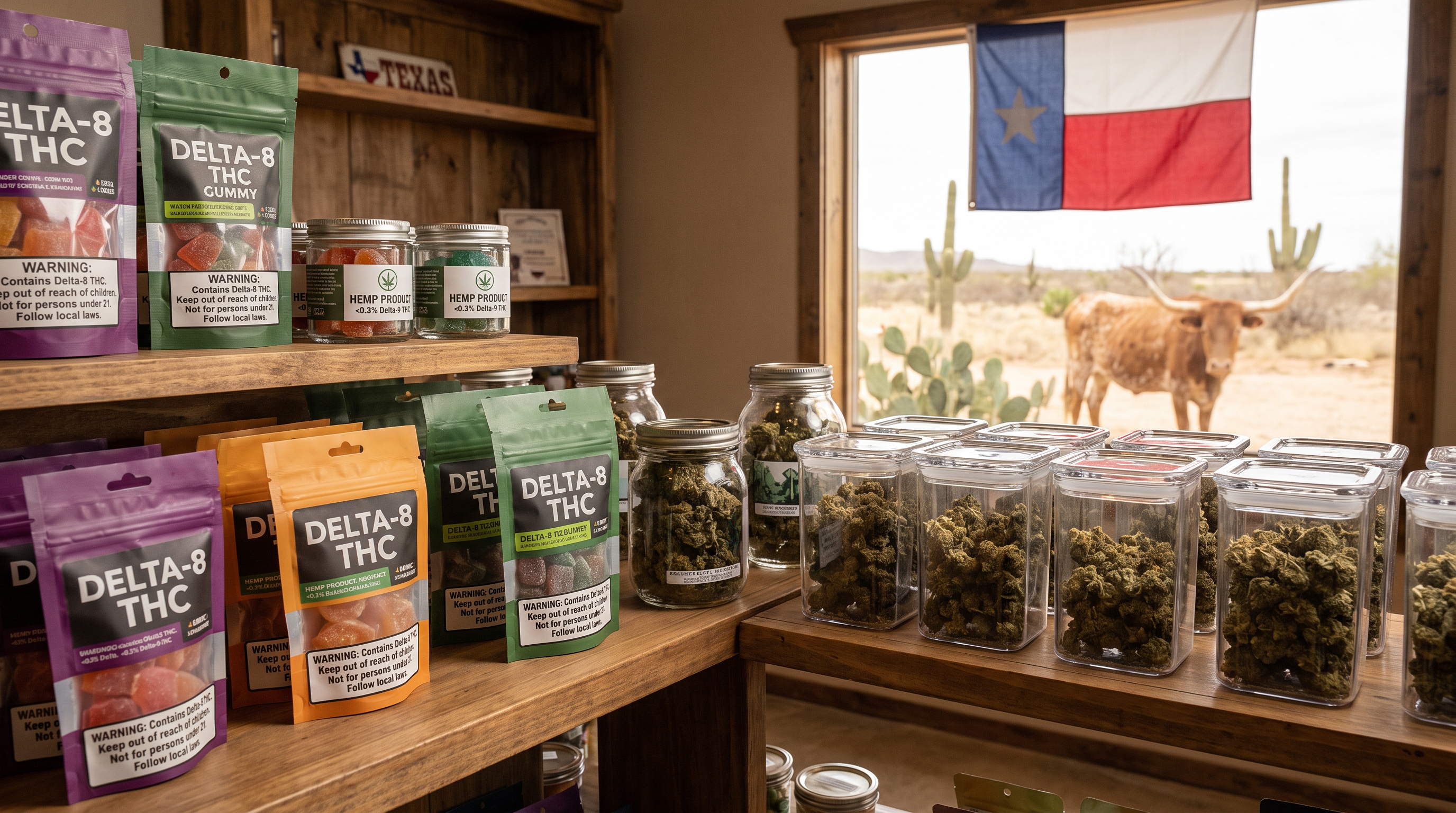
What’s Now Illegal vs. What’s Still Legal in Texas
Products Now Illegal (Effective July 31st, 2026)
- All Delta-8 THC products — gummies, vapes, oils, edibles;
- All Delta-10 THC products — same forms as Delta-8;
- All THCP products — synthetically derived cannabinoids;
- Any THC product testing above 0.3% delta-9 THC by dry weight — this includes THCA flowers and concentrates.
If you have any of these products in your possession right now, in August 2026, you are in possession of illegal controlled substances. That’s not an exaggeration. That’s the law.
Products Still Legal (As of August 2026)
- Delta-9 THC products (if they stay at or below 0.3% by dry weight) — these still qualify as legal hemp;
- CBD (cannabidiol) — no THC content, remains legal;
- CBG (cannabigerol) — legal, no THC;
- CBC (cannabichromene) — legal, no THC.
The key distinction: if it contains THC above 0.3%, it’s illegal. If it’s pure CBD or other non-THC cannabinoids, it’s still legal. But if you’re uncertain what you have, don’t guess—the penalties for getting it wrong are severe.
Criminal Penalties for Possession — Texas Penal Code § 481.121
Possession Penalties by Quantity
Under Texas Penal Code, possession of illegal THC products triggers these penalties:
- Less than 1 gram: State jail felony — up to 2 years in jail + $10,000 fine;
- 1 to 4 grams: Third-degree felony — up to 10 years in prison + $10,000 fine;
- 4 grams to 400 grams: Second-degree felony — up to 20 years in prison + $10,000 fine;
- 400 grams or more: First-degree felony — up to life in prison.
These are not misdemeanors. These are not fines. These are felonies. A felony conviction means a criminal record that affects employment, housing, loan eligibility, voting rights, and gun ownership. A single gram of Delta-8 gummies could send you to jail for 2 years.
Penalties for Retailers and Manufacturers
If you’re a retail owner or manufacturer, the penalties are equally severe:
- Manufacturing license fee: Increased from $250 to $10,000 per year;
- Retail registration fee: Increased from $150 to $5,000 per location;
- Selling to anyone under 21: Automatic license revocation + criminal penalties;
- Product seizure and destruction: The state can seize and destroy your inventory;
- Civil and criminal penalties: Potential imprisonment and additional fines.
This is why you saw on the news that retailers lost 65% of their revenue overnight. They had inventory they thought was legal, and suddenly it’s illegal and subject to seizure.
Facing THC Possession Charges in Texas?
BJ Kemp defends clients charged with drug possession and felonies. Many charges can be dismissed or reduced with proper legal strategy. Free case review available now.
(346) 971–7333 — Free Case ReviewWhat To Do If You’re Facing Charges
Step 1 — Identify What You Have and Dispose Safely
Check your home, car, and belongings. Do you have Delta-8, Delta-10, or THCA flower? If yes, you’re in possession of illegal products right now. Don’t try to sell them or give them away—that’s distribution, which carries even harsher penalties. The safest option is to dispose of them safely. Some communities have drug disposal programs. Check with your local pharmacy or police department.
Step 2 — Know Your Rights (Exercise Your Right to Remain Silent)
If you’re arrested or stopped by police with THC products, remember this: You have a right to remain silent. Use it.
- Don’t explain where you bought the products;
- Don’t say you thought they were legal;
- Don’t answer questions about how long you’ve had them;
- Don’t volunteer any information.
Say only: “I would like to speak to an attorney.” Then stop talking. Anything you say can and will be used against you in court. Your silence is your protection.
Step 3 — Call a Criminal Defense Attorney Immediately
If you’re charged with THC possession, these are felony charges. Call an attorney the same day you’re arrested or charged—not tomorrow, not next week. Today. The sooner your attorney gets involved, the sooner we can file motions to dismiss, challenge the evidence, or negotiate a better outcome.
In many cases, charges can be dismissed or reduced if the search was illegal or if proper procedures weren’t followed. But you have to act fast.
The Federal Lawsuit Challenge — What’s Happening Now
Three days after the Texas ban took effect on July 31st, members of the hemp industry filed a federal lawsuit challenging the law. Their arguments are:
- Federal Farm Bill Preemption: The 2018 federal Farm Bill legalized hemp nationally, and Texas law conflicts with federal authority;
- Void for Vagueness: The law doesn’t clearly define which products are illegal;
- Interstate Commerce: The law violates interstate commerce protections;
- Supremacy Clause: Federal law should override state law on controlled substances.
These are solid legal arguments. But here’s the problem: The hemp industry made similar arguments in the Texas Supreme Court in May 2026 and lost. Federal courts have also been hesitant to overturn state drug laws, even when legal questions exist.
So will this lawsuit succeed? Unknown. But you can’t wait for it. Even if the lawsuit wins, it could take years to wind through the federal courts. Until then—and that could be 2-3 years minimum—you need to assume the Texas law is real and enforceable. Because it is.
Frequently Asked Questions
No. Delta-8 THC became illegal in Texas on July 31st, 2026. Possession of any amount is a state jail felony (up to 2 years in jail + $10,000 fine). This applies to Delta-8 gummies, vapes, oils, and any Delta-8 product. It doesn’t matter if you bought it thinking it was legal—possession is still a felony.
Delta-9 THC is legal in Texas if it’s derived from hemp and stays at or below 0.3% by dry weight (per the 2019 Farm Bill). Delta-8 and Delta-10 are illegal because they’re synthetically derived or don’t fit the hemp definition. The key threshold is 0.3% delta-9 THC. If a product tests above that, it’s a controlled substance.
Yes. The law doesn’t grandfather in products purchased before the effective date. If you have Delta-8 in your possession on August 1st, 2026, it’s illegal. The date you purchased it doesn’t matter legally. However, if you’re charged, your attorney can argue that you didn’t know the law changed, which may affect sentencing or help negotiate a better outcome. But possession itself is illegal regardless of when you bought it.
Selling illegal THC products is a felony. Penalties depend on quantity, but even selling a small amount triggers third-degree to second-degree felony charges (10-20 years in prison). Retailers also face license revocation, fines up to $10,000+ annually, and product seizure. If you’re a retail owner, you need to remove all illegal products from your shelves immediately.
Possibly, but not immediately. The federal lawsuit makes solid arguments about federal Farm Bill preemption and interstate commerce. However, similar arguments failed in the Texas Supreme Court in May 2026. Federal courts move slowly—even if the lawsuit succeeds, it could take 2-3 years or longer. Until then, the Texas law is enforceable. Don’t rely on a potential lawsuit to justify possession.
Sources & Further Reading
- Texas HB 1325 (2019) — Hemp Legalization and the 0.3% Delta-9 Threshold
- Texas Health & Safety Code § 481.121 — Controlled Substance Penalties
- Texas Supreme Court — Case Dockets and Decisions
- Texas Department of State Health Services — Controlled Substance Regulations
- U.S. DEA — Controlled Substances Information

Houston Criminal Defense Attorney — Drug Charges
BJ Kemp
Texas State Bar #24116608 · Texas Legal Giants · Houston, TX
The Texas THC ban is new, and many people don’t understand the penalties. BJ Kemp defends clients charged with drug possession and felonies related to Delta-8, Delta-10, THCA, and other controlled substances. Many charges can be dismissed or reduced with proper legal strategy and aggressive defense. If you’re facing charges, call immediately for a free case review.
(346) 971–7333 — Free Case Review