
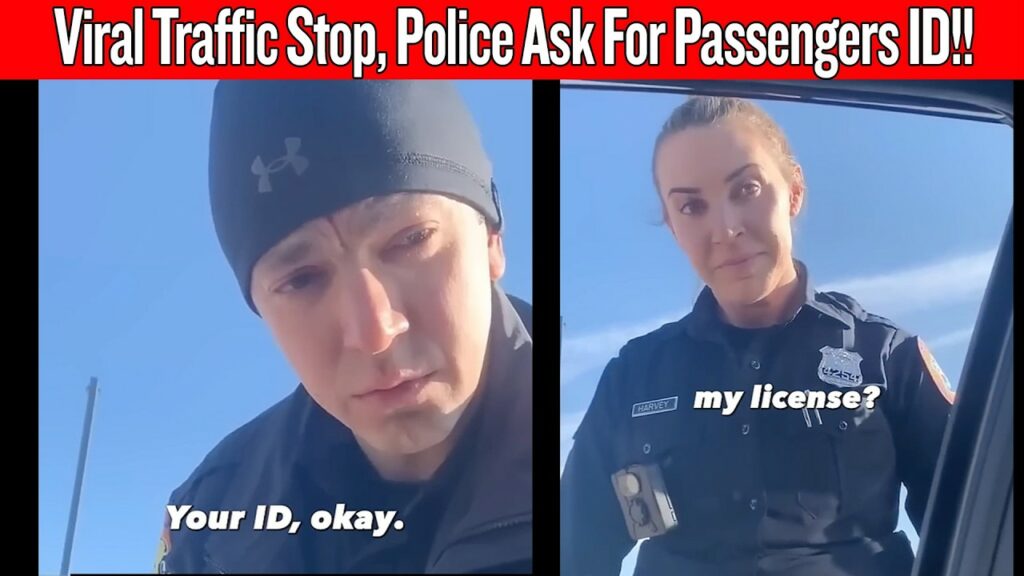
A viral traffic stop shows a passenger refusing to provide ID to a police officer—and the officer eventually admitting she was wrong. But here’s what most people miss: the passenger knew their constitutional rights under the Fourth Amendment, and they knew the difference between an officer asking for ID and demanding it. In Texas, that distinction can mean the difference between a lawful traffic stop and an illegal seizure. This guide explains exactly when you must provide ID as a passenger and when you can legally refuse.
Watch the Viral Traffic Stop That Sparked This Legal Debate
Understanding Passenger Rights During Traffic Stops in Texas
The Viral Traffic Stop — What Really Happened
A driver gets pulled over for tinted windows—a legitimate traffic violation. The officer comes to the passenger window and demands the passenger’s ID. When the passenger asks why, the officer says “something came up” but doesn’t explain clearly. A second officer then arrives and mentions a warrant—but here’s the critical issue: the warrant isn’t for the driver or the passenger. It’s for the driver’s uncle, who isn’t even in the vehicle. The passenger correctly points out that the uncle’s warrant has nothing to do with them, and tells the officer she violated their rights. The officer eventually concedes: “You’re allowed to refuse.”
This exchange highlights a fundamental misunderstanding most people have about traffic stops. A passenger is NOT automatically required to identify themselves just because the vehicle was stopped. The stop was based on a traffic violation by the driver. The passenger did nothing wrong. Under Texas law and the U.S. Constitution, that matters legally.
Brendlin v. California and Rodriguez v. United States — The Supreme Court Cases That Protect You
Two Supreme Court cases establish your rights as a passenger during a traffic stop:
Brendlin v. California (2007) held that passengers are “seized” during a traffic stop, meaning they are not free to leave. Because passengers are seized, they receive Fourth Amendment protection against unreasonable searches and seizures. However, being seized does not automatically give police authority to demand your ID without cause.
Rodriguez v. United States (2015) established that police cannot extend a traffic stop longer than necessary to handle the reason for the original stop. If you’re pulled over for tinted windows, the stop is about the windows—not about investigating the passenger. If an officer tries to demand your ID based on an unrelated reason (like a vague warrant or a hunch), that extends the stop beyond its original purpose, which is illegal.
Asking vs. Demanding — The Critical Legal Distinction
Here’s the distinction that most people miss, and it’s absolutely critical: An officer can ask for your ID. A passenger being required to provide ID is different and requires reasonable suspicion or probable cause specific to that passenger.
An officer asking for identification is permissible. You can decline to answer. An officer demanding identification—treating it as a legal requirement—without reasonable suspicion or probable cause to believe you committed a crime is a Fourth Amendment violation. The demand itself, the assertion of authority without legal justification, is what crosses the line into illegal conduct.

What Gives Police Reasonable Suspicion or Probable Cause During a Traffic Stop
What DOES Create Reasonable Suspicion for Investigating a Passenger
There are specific, articulable facts that give an officer reasonable suspicion to investigate a passenger more closely or request ID:
- Odor of marijuana or alcohol coming from inside the vehicle (suggesting the passenger may be under the influence or in possession of contraband);
- A weapon in plain view where possession may be unlawful;
- Open containers of alcohol in the vehicle;
- Drug paraphernalia visible in plain sight;
- Admission by the driver or passenger that someone in the car engaged in criminal activity;
- Specific, articulable facts suggesting a crime is being committed or has been committed by that specific person (not just hunches or vague concerns).
The key is specificity. The officer must point to specific facts that suggest you—the passenger—may have committed a crime or are engaged in criminal activity.
What DOES NOT Create Reasonable Suspicion for a Passenger
These reasons alone do NOT justify demanding a passenger’s ID:
- The driver violated a traffic law (tinted windows, speeding, running a red light). The passenger didn’t break the law; the driver did.
- An unrelated warrant for someone not in the vehicle (like the driver’s uncle);
- An officer’s hunch or feeling that “something came up” without explaining what;
- A desire to “run names” through the computer system;
- Mere presence in the vehicle with someone who committed a traffic violation.
Officers sometimes use vague language—”something came up,” “I need to check something”—to justify extending a stop. This is precisely what the Rodriguez case prohibits. An officer must articulate a specific, constitutional reason for the extended investigation.
Know Your Rights as a Passenger — Then Exercise Them Safely.
BJ Kemp helps people who’ve been wrongfully detained or had their constitutional rights violated during traffic stops. Free case review—we fight for your Fourth Amendment rights in court.
(346) 971–7333 — Free Case Review7 Critical Actions To Take If Police Demand Your ID as a Passenger
1. Stay Calm and Don’t Escalate
Your first instinct should be de-escalation. The passenger in the viral video handled this perfectly—they stayed calm, asked clarifying questions, and didn’t raise their voice or become physically confrontational. Remaining calm protects your safety and preserves your legal position. An officer may claim you were “aggressive” or “uncooperative” if you escalate, which can complicate your case later.
2. Exercise Your Right to Remain Silent
You have a Fifth Amendment right to remain silent. You are not required to answer questions or volunteer information. A practical approach: don’t volunteer extra details. If an officer asks “Where are you going?” you can simply say “I’d prefer not to answer” or remain silent. You’re not required to explain yourself or talk your way out of the situation.
3. Ask Clarifying Questions to Force the Officer to Articulate Cause
You can ask questions like:
- “What crime do you suspect I’ve committed?”
- “Do you have reasonable suspicion that I committed a crime?”
- “Why are you asking me for ID when I’m not the driver?”
- “What is the legal basis for this request?”
These questions force the officer to either explain their legal justification or admit they don’t have one. However, remember: you’re not required to ask questions. You can simply invoke your right to remain silent instead.
4. Clearly State: “I Would Like to Speak to an Attorney”
If an officer continues questioning you or if you feel the situation is escalating, make this statement once, clearly: “I would like to speak to an attorney.” Repeat it if necessary, but say it just once initially. Once you invoke this right, the officer is legally required to stop questioning. This is one of the most powerful tools you have during a traffic stop.
5. Comply If You Fear for Your Safety
If an officer continues to pressure you and you fear for your physical safety, comply with the request for ID. Your safety is the priority. You will have your day in court, and a qualified criminal defense attorney can file a motion to suppress any evidence obtained through an illegal stop or seizure. The courtroom is where your Fourth Amendment violation gets remedied—not on the side of the road.
6. Document Everything at the Scene
If possible and safe to do so, mentally note:
- Officer’s name and badge number (ask for it: “May I have your name and badge number?”)
- Time and location of the stop;
- Exactly what was said by the officer (the words used matter legally);
- Any witnesses present (get their names and contact information if possible);
- Description of the vehicle and patrol car (unit number).
If you can safely record video, do so. Recording police in public is a constitutional right in Texas and most states.
7. Call Your Attorney Immediately
After the stop, call a criminal defense attorney immediately—even if you weren’t arrested. Explain exactly what happened, in order, without editorializing. Your attorney can evaluate whether your Fourth Amendment rights were violated and file a motion to suppress any evidence obtained through an illegal stop or seizure. Suppressed evidence often results in dismissed charges.
Texas Penal Code § 38.02 — Failure to Identify: What It Actually Says
One statute that comes up constantly in these situations is Texas Penal Code § 38.02 (Failure to Identify). Many officers cite this statute to justify demanding a passenger’s ID, but the statute actually does NOT require a passenger to identify themselves during a routine traffic stop.
Here’s what the statute actually says: A person commits an offense if they intentionally refuse to provide their name, residence address, or date of birth to a police officer who lawfully arrests them, or if they are lawfully detained and the officer has reasonable suspicion that the person committed a crime.
The critical language: “lawfully detained” and “reasonable suspicion that the person committed a crime.” You must be detained for a separate, specific crime—not merely because you happen to be in a car that was pulled over for a traffic violation. If an officer tries to use § 38.02 to force you to provide ID as a passenger during a traffic stop for which you have no connection, that’s exactly the kind of case Texas Legal Giants fights in court.
Frequently Asked Questions
No, not without reasonable suspicion or probable cause that you committed a crime. The officer can ask, but they cannot demand it. If the traffic violation (tinted windows, speeding) involves only the driver, the passenger has not violated any law. An officer extending the stop to demand the passenger’s ID for an unrelated reason violates Rodriguez v. United States, which prohibits extending a traffic stop beyond its original purpose.
Ask the officer: “Am I lawfully detained for a specific crime?” If the answer is no—if you’re only detained because you’re in a vehicle pulled over for a traffic violation—then § 38.02 does not apply to you. The statute requires that you be detained for a separate, specific crime. If the officer cannot articulate a specific crime you committed, you can refuse to provide ID. If the officer insists and you fear for your safety, comply and call your attorney immediately.
An officer can ask for your ID. When you refuse, that’s the end of it—you have the right to refuse a request. An officer demanding ID treats it as a legal requirement and asserts authority over you. A demand without reasonable suspicion or probable cause is a Fourth Amendment violation. The Supreme Court case Landeros v. United States makes clear that the demand itself—the assertion of authority without legal justification—is what creates the constitutional violation.
If the officer lacks reasonable suspicion or probable cause, they cannot lawfully arrest you for refusing to provide ID. If they do arrest you, that arrest is illegal, and any evidence obtained as a result can be suppressed in court. However, if you fear for your safety during the encounter, you may choose to comply and later challenge the legality in court. Your safety comes first; the courtroom is where you fight for your rights.
Yes. If your Fourth Amendment rights were violated, your attorney can file a motion to suppress any evidence obtained as a result of that illegal seizure or stop. Common outcomes include dismissal of charges, suppression of contraband found in the vehicle, or suppression of statements you made. If you were wrongfully detained, arrested, or had your rights violated, call a criminal defense attorney immediately to discuss your legal options.
Sources & Further Reading
- Texas Penal Code § 38.02 — Failure to Identify
- Brendlin v. California, 551 U.S. 249 (2007) — Passenger Seizure in Traffic Stops
- Rodriguez v. United States, 575 U.S. 348 (2015) — Duration of Traffic Stops
- Fourth Amendment — Search and Seizure Protections
- U.S. Department of Justice — Civil Rights Resources on Police Conduct

Houston Criminal Defense Attorney
BJ Kemp
Texas State Bar #24116608 · Texas Legal Giants · Houston, TX
Traffic stops involving illegal ID demands, illegal searches, or rights violations require immediate legal action. BJ Kemp fights for clients whose Fourth Amendment rights have been violated during police encounters, filing motions to suppress and getting charges dismissed when evidence was obtained illegally. Your constitutional rights are not negotiable on the side of the road—they’re defended in court.
(346) 971–7333 — Free Case Review