
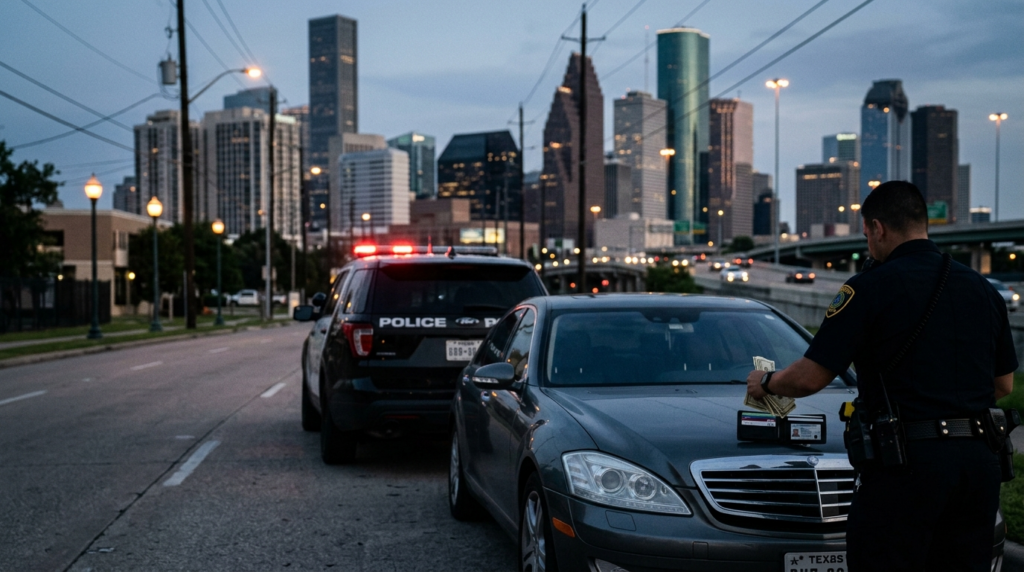
Yes — police in Texas can take your cash without arresting you, without charging you, and without ever proving you committed a crime. It happens under Chapter 59 of the Texas Code of Criminal Procedure, and the state has exactly 30 days from the date of seizure to file its case in court. Miss your own deadline to respond, and the money is gone by default.
A viral video making the rounds shows an officer walking away with a man’s cash and telling him to “go bring proof.” That phrase gets the law backwards — and understanding why is the difference between recovering your money and losing it permanently.
Two Different Ways Texas Police Can Take Your Cash
When an officer takes money off you, one of two legal processes is starting — and they work nothing alike. Texas law enforcement agencies reported $39.6 million in state forfeiture revenue in 2023 alone, so this is not a rare edge case.
Seizure as Evidence of a Crime
The first path is ordinary criminal evidence. Officers can seize cash they believe proves or relates to an offense — but that requires probable cause and a lawful basis under the Fourth Amendment, which protects against unreasonable searches and seizures. Money held as evidence stays in a property room and is tied to a criminal case. You get it back through a release form and a court order when the case resolves in your favor.
The catch is that “held as evidence” and “being forfeited” can look identical from the property room counter. In the viral clip, the man was told his money and bag were logged as evidence — on a citation involving a moped on a sidewalk. Nobody at the counter explained which process he was actually in.
Civil Asset Forfeiture Under Chapter 59
The second path is the one most people have never heard of. Under Article 59.01 of the Texas Code of Criminal Procedure, cash can be labeled contraband — property used in, intended for use in, or derived from certain felonies and listed offenses. Once it carries that label, the state can move to keep it permanently through a civil lawsuit.
Here is the part that catches people off guard: the case is filed against the property itself, not against you. Style like State of Texas v. $8,400 in U.S. Currency is not a joke — it is how these petitions are actually captioned. Because it is a civil action against the cash, you do not have to be arrested, charged, or convicted for the state to go after it. As of September 1, 2025, Senate Bill 1498 expanded the contraband definition to cover digital currency, NFTs, and stablecoins too.
The 30-Day Clock That Decides Whether You Get Your Money Back
Forfeiture cases are won and lost on calendar dates, not on who was right at the roadside. There are two deadlines, and one of them is yours.
The State’s Deadline: 30 Days to File
Article 59.04(a) is direct: “the attorney representing the state shall commence proceedings under this section not later than the 30th day after the date of the seizure.” The prosecutor files a notice of seizure and intended forfeiture with the district clerk in the county where the money was taken, backed by the seizing officer’s sworn statement listing the property and the reasons for taking it.
Separately, Article 59.03(c) gives the officer 72 hours to place the seized property under seal, move it where a court orders, or hand custody to another agency. When the state lets the 30-day mark pass without filing, that failure becomes a direct argument for the return of your property — and it is one of the first things a forfeiture lawyer checks.
Your Deadline: Answer or Lose by Default
Article 59.04(b) requires the state to serve you with certified copies of the notice “in the same manner as provided for the service of process by citation in civil cases.” That matters, because it pulls in the ordinary civil answer deadline: your written answer is due by 10:00 a.m. on the Monday following the expiration of 20 days after you were served.
If no answer gets filed, the state can take a default judgment and keep the money without ever proving anything. This is why “go bring proof” is such dangerous advice — proof delivered to an officer at a property room counter is not an answer filed with a district court, and it does nothing to stop that clock. If an envelope shows up from a district attorney’s office, it is almost certainly a response deadline, not junk mail.

Why the State Only Has to Clear the Lowest Bar in the Law
A criminal conviction requires proof beyond a reasonable doubt. A forfeiture case does not come close to that.
Preponderance of the Evidence — 50.1% Is Enough
Article 59.05 puts forfeiture cases on the civil track: they “proceed to trial in the same manner as in other civil cases,” and “the state has the burden of proving by a preponderance of the evidence that property is subject to forfeiture.” Preponderance means more likely than not — functionally 50.1%. It is the lowest standard of proof in American law, and it is what stands between a citizen and permanent loss of their cash.
One protection does exist in the same article: if you were acquitted of the underlying offense, that acquittal raises a presumption that the property is nonforfeitable. But note what that requires — a charge and a trial. The people hit hardest by forfeiture are the ones who were never charged at all, so they never get the benefit of that presumption.
The Innocent Owner Defense — and Who Has to Carry It
Under Article 59.02(c), an owner who was not involved in the offense can defeat forfeiture by proving, by a preponderance of the evidence, that they acquired the property before the illegal conduct and did not know it was likely to occur, or acquired it afterward for value without reasonably knowing it was contraband. The Institute for Justice grades Texas forfeiture law a D+ largely for this reason: the burden of establishing innocence lands on the property owner.
There is also a step most people miss. Article 59.02(b) allows an owner to replevy — post a bond and get the property back while the case is still pending, rather than waiting months for a final judgment.
Did Police Take Your Cash or Property in Texas?
The 30-day clock started the day they took it. Get your rights explained before the deadline passes — your first call is free.
(346) 971-7333 — Free Case ReviewWhat the Numbers Actually Show About Forfeiture in Texas
This system is not theoretical, and the scale is documented.
Where the Money Goes
Between 2000 and 2023, Texas agencies pulled in at least $1.8 billion in combined state and federal forfeiture revenue, with $988.2 million of that coming through state forfeiture alone. Under Chapter 59’s disposition rules, local law enforcement and prosecutors can retain a large share of what they take — the Institute for Justice puts it at up to 70% in uncontested cases and as much as 100% in contested ones, depending on the local sharing agreement. When the agency that seizes the property also funds itself from the property, the incentive problem is structural, not personal.
Tenaha — What Happens When the Incentive Runs Unchecked
Between 2006 and 2008, officials in Tenaha, Texas stopped motorists — disproportionately Black and Latino drivers passing through — and seized cash, jewelry, and vehicles from people who were never charged with a crime. The ACLU’s class action, Morrow v. City of Tenaha, covered an estimated $3 million taken in at least 140 cases. The 2012 consent decree that resolved it now requires every stop to be videotaped, requires officers to state the reason for the stop, and requires motorists to be told orally and in writing that they can refuse a search.
That case is also where the waiver rule bites. Article 59.03(d) states that a peace officer “may not request, require, or in any manner induce any person” to sign a document waiving their interest in seized property, and Article 59.03(e) applies the same prohibition to prosecutors before notice is filed. The same subsection confirms you may assert your interest in the property at the time of seizure — out loud, on camera, at the roadside.
What To Do in the First 72 Hours After Police Take Your Money
What happens in the first three days shapes the entire case.
At the Scene
- Never physically resist. Comply with lawful commands — an obstruction or resisting charge hands the state the criminal predicate it may otherwise lack.
- Ask the two questions on camera: “Am I being detained?” and “Am I free to go?” Both answers matter later to the Fourth Amendment analysis.
- State your claim out loud: “This is my money and I am asserting my interest in it.” Article 59.03(d) expressly preserves that right.
- Record badge number, name, and agency for every officer present, plus the exact location and time of the seizure.
- Do not sign anything. Any document waiving your interest in the property is prohibited under Articles 59.03(d) and (e) — and signing one can cost you everything.
In the Days After
- Request the body camera footage in writing through a Texas Public Information Act request to the seizing agency, and do it early — retention windows can be as short as 90 days.
- Gather proof the money was lawfully yours: bank withdrawal slips, pay stubs, 1099s, settlement checks, business receipts, sale documents. The state’s theory is that the cash is criminal proceeds; documented origin is what defeats it.
- Get the written inventory — the schedule of seized property from the officer’s sworn statement under Article 59.03(c) — and compare the listed amount against what you actually had.
- Call a lawyer inside the first week. Between the state’s 30-day filing deadline and your roughly 20-day answer window, the entire case can be decided in under two months.
- Open every piece of mail from a district clerk or district attorney the day it arrives. That envelope is the deadline.
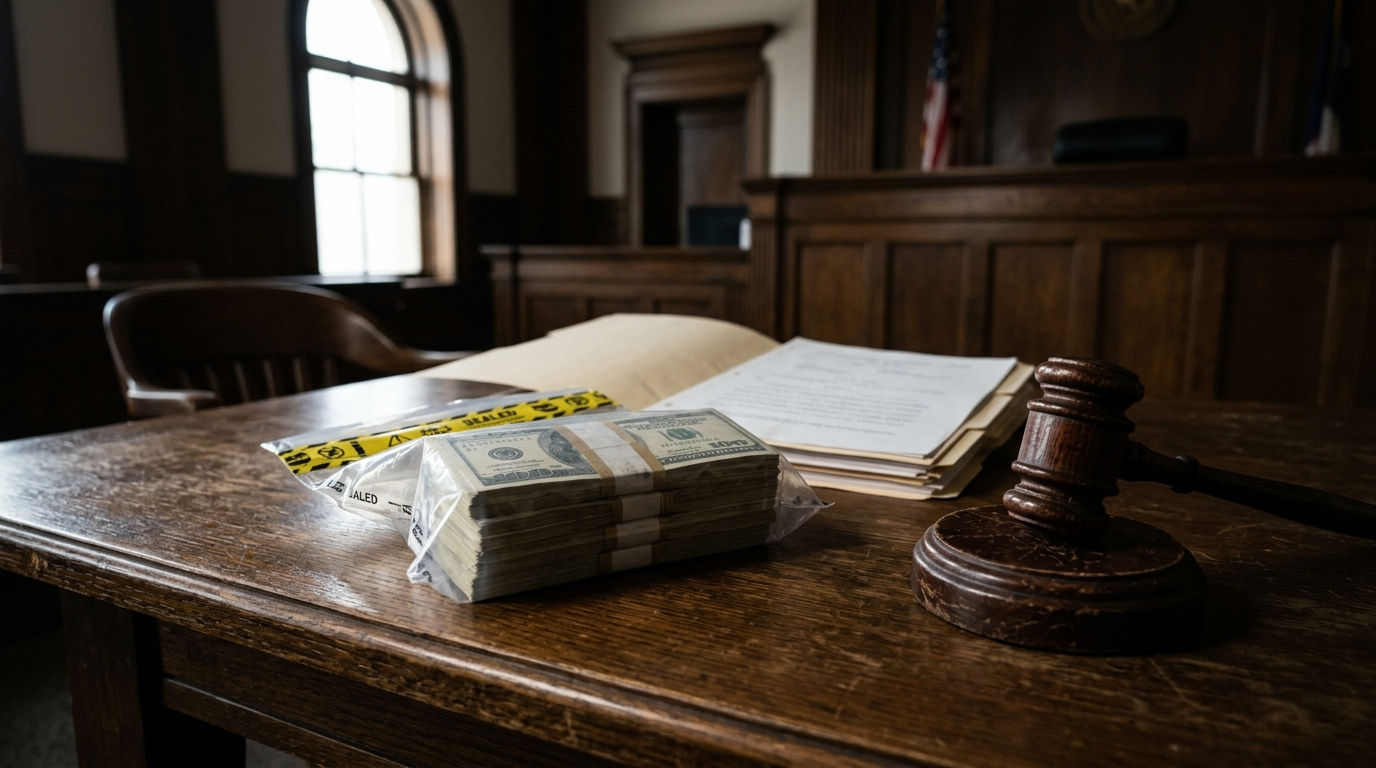
One honest caveat: a 20-second video never shows the whole stop. We rarely know what preceded the clip, why the stop happened, or what the officer had already observed. An officer failing to explain himself on camera does not automatically make a seizure illegal — and it does not make it legal either. That is exactly what the court file is for.
Whether your situation started with a traffic stop, a search, or a knock at the door, the legal questions are the same ones we walk through with clients every week — the same rights at issue when police demand ID from a passenger during a Texas traffic stop. If the encounter also left you hurt or your property damaged, a Texas personal injury attorney can evaluate those claims alongside the forfeiture. You can also reach our Houston office directly to get the clock and your options mapped out.
Frequently Asked Questions
Can police take your money in Texas without charging you with a crime?
Yes. Civil asset forfeiture under Chapter 59 of the Texas Code of Criminal Procedure is filed against the property itself, not against a person, so no arrest, charge, or conviction is required. The state only has to prove by a preponderance of the evidence — 50.1% — that the money is contraband under Article 59.01. Texas agencies reported $39.6 million in state forfeiture revenue in 2023.
How long do Texas police have to file a forfeiture case after taking your property?
Article 59.04(a) requires the attorney representing the state to commence forfeiture proceedings no later than the 30th day after the date of seizure, by filing a notice of seizure and intended forfeiture with the district clerk. Separately, Article 59.03(c) gives the seizing officer 72 hours to seal the property or transfer custody. If the state misses the 30-day deadline, that failure is a direct basis to seek return of the property.
How do I get my money back after police seize it in Texas?
You must file a written answer in the district court where the notice was filed — it is due by 10:00 a.m. on the Monday following 20 days after service, because Article 59.04(b) requires service in the same manner as civil citation. You can also replevy under Article 59.02(b) by posting a bond to recover the property while the case is pending. Failing to answer lets the state take a default judgment and keep the money permanently.
Can an officer make you sign away your seized property at the scene?
No. Article 59.03(d) prohibits a peace officer from requesting, requiring, or in any manner inducing anyone to execute a document waiving their interest in seized property, and Article 59.03(e) extends that same prohibition to prosecutors before the notice of seizure is filed. The same subsection confirms you may assert your interest in the property at the time of seizure. If you were pressured into signing a waiver, tell your attorney immediately.
Does an acquittal mean you automatically get your seized money back in Texas?
Not automatically, but it helps significantly. Under Article 59.05, evidence of an acquittal on the underlying offense raises a presumption that the property is nonforfeitable, which shifts the practical burden back onto the state. If you were never charged at all, that presumption never applies — which is why so many uncharged owners still have to litigate under the innocent owner defense in Article 59.02(c).
Sources & Further Reading
- Texas Code of Criminal Procedure, Chapter 59 — Forfeiture of Contraband
- Article 59.04 — Notification of Seizure and Intended Forfeiture (30-day deadline)
- Article 59.03 — Seizure of Contraband and the Waiver Prohibition
- Texas SB 1498 (89th Legislature, effective September 1, 2025) — Digital Asset Forfeiture
- Institute for Justice, Policing for Profit — Texas State Profile
- ACLU — Morrow v. City of Tenaha

Your Texas Property Seizure & Civil Rights Attorney
BJ Kemp
Texas State Bar #24116608 · Texas Legal Giants · Houston, TX
When police take your cash, the law gives you weeks — not months — to fight back, and most people don’t learn that until the deadline has already passed. I break down exactly what was seized, whether the state filed on time, and what it takes to get your property returned. Call me before you sign anything or hand over a single document.
(346) 971–7333 — Free Case Review