
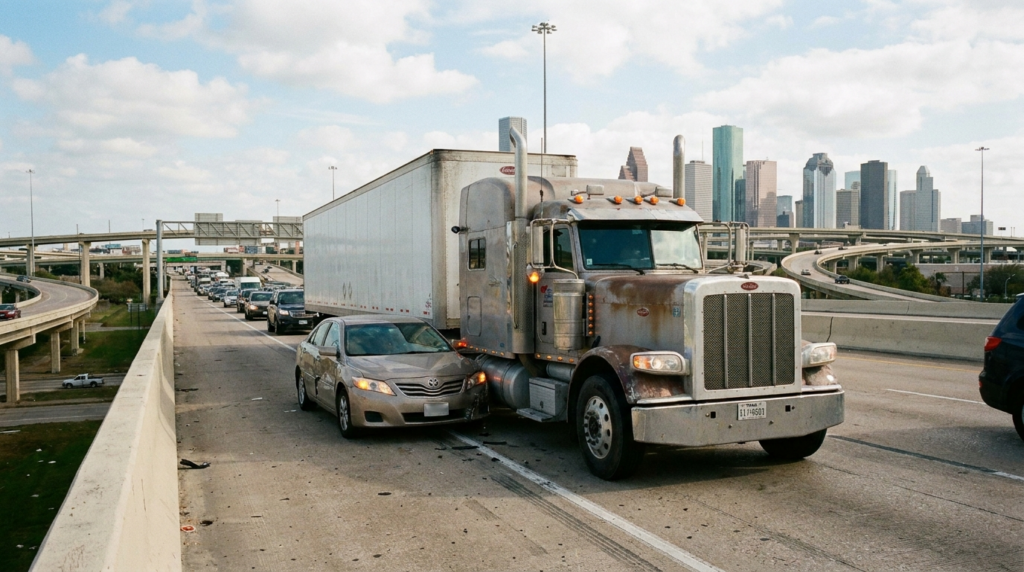
Houston is one of the most truck-heavy cities in America. The Port of Houston is one of the busiest in the country, I-10 through Houston is the widest freeway in the world at some points, and I-45, I-69, and Beltway 8 carry tens of thousands of commercial trucks every day. That volume translates to a high rate of serious truck accidents — and some of the most devastating injuries any personal injury attorney handles.
If you or someone you love has been hurt in a collision with an 18-wheeler, semi-truck, tanker, or other commercial vehicle, you need to understand something fundamental: truck accident cases are a different animal from car accident cases. They are more complex, they move faster in the first hours and days, and the trucking company’s insurers will be better-prepared than in almost any other type of claim. You should be too.
Why Truck Accidents Cause Catastrophic Injuries
The physics of truck accidents are brutal. A fully loaded 18-wheeler can weigh up to 80,000 pounds — the federal legal maximum for interstate highways. The average passenger car weighs about 3,000–4,500 pounds. When these two vehicles collide, the size and weight disparity is the dominant factor in the outcome.
The kinetic energy in a crash increases with the square of velocity and linearly with mass. A truck hitting a car at 60 mph delivers roughly 20 times the energy of a car-to-car collision at the same speed. What crushes a car’s crumple zone and trips airbags in a typical crash can override safety systems entirely in a truck collision.
Common catastrophic injuries in Houston truck accidents include:
- Traumatic brain injury (TBI) — ranging from concussion to severe brain damage
- Spinal cord injury — potentially causing partial or complete paralysis
- Crush injuries to the chest, abdomen, and pelvis
- Amputations from severe crush or rollover accidents
- Severe burns in accidents involving fuel spills and fires
- Multiple fractures including femur, pelvis, and spinal fractures
- Internal organ damage requiring emergency surgery
- Death — truck accidents are among the deadliest types of motor vehicle crashes
According to NHTSA data, occupants of passenger vehicles account for approximately 97% of fatalities in crashes involving large trucks. The truck driver and vehicle are typically far better protected than the people they hit.
Federal Regulations Trucking Companies Must Follow
Commercial trucking is one of the most heavily regulated industries in America. The Federal Motor Carrier Safety Administration (FMCSA) establishes detailed rules governing every aspect of commercial truck operation. Violations of these rules are direct evidence of negligence — and often the key to proving liability in a truck accident case.
Hours of Service (HOS) Rules
Driver fatigue is one of the leading causes of truck accidents. FMCSA regulations limit how many hours truck drivers can operate:
- Maximum 11 hours of driving after 10 consecutive hours off duty
- No driving after 14 consecutive hours on duty
- Required 30-minute break after 8 hours of driving
- Maximum 60/70 hours on duty in 7/8 consecutive days
These rules are enforced through Electronic Logging Devices (ELDs), which automatically record driving time. But pressure from dispatchers and shipper deadlines pushes some drivers to falsify logs or drive beyond legal limits anyway.
Maintenance and Inspection Requirements
Trucking companies must conduct pre-trip inspections, maintain detailed maintenance records, and repair defects that affect safety before operating the vehicle. Brake failures, tire blowouts, and steering defects that cause accidents are often traceable to maintenance violations documented in the carrier’s own records.
CDL Requirements and Driver Qualifications
Commercial drivers must hold valid Commercial Driver’s Licenses (CDL), pass medical certifications, and maintain clean driving records. Trucking companies must conduct background checks on new hires and cannot employ drivers with disqualifying convictions. Negligent hiring — putting a driver with a dangerous history behind the wheel — is a significant source of liability.
Cargo Securement Rules
Improperly loaded or secured cargo can cause trucks to tip, roll, or spill, creating catastrophic hazards. FMCSA cargo securement regulations specify how different types of cargo must be tied down. Violations are common and dangerous.
Drug and Alcohol Testing
Commercial drivers are subject to pre-employment, random, post-accident, and reasonable-suspicion drug and alcohol testing. A driver who tests positive after your accident is powerful evidence — but testing must happen quickly for results to be meaningful.

Multiple Potentially Liable Parties
One of the most significant differences between truck accident cases and car accident cases is the number of parties who may share liability. Identifying all of them is critical — because each one may carry separate insurance coverage, and recovering from all of them is how you ensure your damages are fully compensated.
The Truck Driver
The driver is personally liable for their own negligent acts: distracted driving, impaired driving, speeding, illegal lane changes, following too closely, and hours-of-service violations. In some cases, the driver is an independent contractor — which affects how liability flows to the trucking company.
The Trucking Company (Motor Carrier)
The motor carrier is liable for its own negligence (hiring, training, supervision, maintenance) and may be vicariously liable for the driver’s acts under the doctrine of respondeat superior if the driver was an employee acting within the scope of their employment. Even when carriers use independent contractors, FMCSA regulations often still impose liability on the carrier whose placard the truck bears.
The Cargo Loader or Shipper
If improperly loaded or secured cargo caused or contributed to the accident — a shifting load that caused the driver to lose control, an overloaded truck with failed brakes, a spilled load that created a road hazard — the cargo loader or shipper can be held liable separately from the driver and carrier.
The Truck or Parts Manufacturer
When a mechanical failure causes or contributes to the accident — brake failure, tire failure, steering failure, trailer coupling failure — the manufacturer of the defective component can be liable under products liability theory. This requires preserving the truck and defective component as evidence.
The Maintenance Company
Some trucking companies contract out their maintenance to third-party shops. If faulty maintenance work caused the mechanical failure, that maintenance provider can be independently liable.
Black Box and Electronic Logging Device (ELD) Data
Modern commercial trucks are rolling data centers. The evidence they contain can make or break a truck accident case — but it must be preserved immediately.
Event Data Recorder (Black Box)
Like airplane black boxes, truck EDRs record critical pre-crash data: speed in the seconds before impact, brake application, steering input, engine throttle, and cruise control status. This data objectively establishes what the truck was doing — and what the driver was or wasn’t doing — in the moments that led to the crash.
Electronic Logging Device (ELD)
Mandatory for most commercial trucks since the FMCSA ELD mandate took effect, ELDs automatically record driving time and provide a much more accurate record than paper logs. ELD data can prove hours-of-service violations that paper logs would hide.
Dashcam Footage
Many trucking companies equip their vehicles with forward-facing and driver-facing cameras. This footage can show the driver’s behavior (phone use, drowsiness, inattention) and the circumstances of the crash. It can also be exculpatory — but the default assumption should be that it exists and must be preserved.
Critical warning: ELD data is typically overwritten within 30 days. Black box data can be overwritten in a subsequent event. Dashcam footage is often stored on a loop. Your attorney must send a spoliation letter — a legal demand to preserve evidence — within days of the accident. Failure to do so can result in this critical evidence being destroyed, legally or accidentally.
Why Evidence Preservation Is Critical and Time-Sensitive
The trucking company’s response to a serious accident is immediate and organized. They have crisis management protocols, and their insurer’s adjusters and defense attorneys are often on-site within hours of a major crash. They are preserving evidence favorable to them — and may not be preserving evidence unfavorable to them.
Your attorney must act with equal urgency:
- Same day or next day: Send spoliation letters to the trucking company, their insurer, and all other potentially liable parties demanding preservation of all evidence
- Within days: Retain an accident reconstruction expert to document the scene, photograph evidence, and begin the technical analysis
- Within 30 days: Secure ELD data through subpoena or preservation demand before it’s overwritten
- Before repairs: Inspect and document the truck, trailer, and cargo before the trucking company repairs or replaces components
- Witness contact: Interview eyewitnesses before memories fade and contact information becomes unavailable
Common Causes of Houston Truck Accidents
Houston’s highway network creates specific truck accident risk patterns that experienced Houston attorneys know well:
I-10 (The Katy Freeway)
One of the busiest freight corridors in America, I-10 between downtown Houston and Katy sees massive truck traffic at all hours. Lane merge accidents, rear-end crashes in construction zones, and accidents at the interchange with I-610 are particularly common.
I-45 (The Gulf Freeway and North Freeway)
I-45 connects Houston to Galveston and Dallas, carrying heavy freight in both directions. The stretch through downtown and the medical center is notorious for truck accidents, as is the segment near the Hardy Toll Road interchange.
Beltway 8 (Sam Houston Tollway)
The Beltway loops around Houston and is heavily used by trucks accessing the Port of Houston, distribution centers, and industrial facilities throughout Harris County. High-speed merge points and truck traffic from the Port create significant accident risk.
I-69 (Southwest Freeway and Eastex Freeway)
I-69 is a primary NAFTA trade corridor, with heavy cross-border freight movement and associated risks throughout the Houston segment.
Port of Houston Access Routes
Trucks accessing the Port from Clinton Drive, Wayside Drive, and related corridors create accident risk in areas where residential and commercial zones interface with heavy industrial truck traffic.
What Your Truck Accident Case May Be Worth
Truck accident cases often involve higher damages than car accident cases for two reasons: the injuries are typically more severe (meaning higher medical costs, greater lost income, and larger non-economic damages), and commercial carriers are required by federal law to carry substantially higher insurance limits.
Federal FMCSA regulations require:
- At least $750,000 in liability coverage for carriers transporting general freight in interstate commerce
- At least $1,000,000 for carriers transporting hazardous materials in certain categories
- At least $5,000,000 for carriers transporting the most dangerous hazardous materials
Most major carriers carry $1 million or more, and some carry $10 million or higher. This means there is typically far more insurance available to compensate serious injuries than in standard car accident cases — but the carrier will deploy equally sophisticated lawyers to protect it.
Seven-figure settlements and verdicts in Houston truck accident cases are not uncommon when injuries are catastrophic. The key variables: severity and permanence of injuries, clarity of liability, which parties can be held responsible, and the quality of your legal representation.
Why You Need a Specialized Attorney, Not Just Any PI Lawyer
The trucking industry is represented by specialized defense firms that handle truck accident claims exclusively. They know FMCSA regulations inside and out. They have retained experts in accident reconstruction, biomechanics, trucking operations, and medical care. They understand how to attack the admissibility of black box and ELD data. They are very, very good at what they do.
You need someone in your corner with equivalent depth. A generalist personal injury attorney who handles occasional truck cases will be outmatched at every turn. You need an attorney who:
- Understands FMCSA regulations and how violations translate to liability
- Has relationships with qualified accident reconstruction and trucking operations experts
- Knows how to read and use ELD data and black box downloads
- Has experience identifying and pursuing all potentially liable parties
- Is prepared to litigate aggressively if the insurer won’t make a fair offer
At Texas Legal Giants, BJ Kemp handles truck accident cases throughout the Houston area with the same commitment and intensity he brings to every case: Big Commitment. Giant Results. When trucking companies and their insurers deploy their best team, you deserve no less.
Frequently Asked Questions
Federal regulations, multiple liable parties, specialized evidence (ELD, black box, driver logs, maintenance records), higher insurance limits, and more severe injuries make truck cases significantly more complex. The trucking company’s insurer will deploy experienced defense counsel immediately — you need an equally prepared attorney.
Potentially: the driver, the trucking company, the cargo loader or shipper, the truck or parts manufacturer, and the maintenance company. Identifying all liable parties and pursuing all available insurance coverage is essential to maximizing your recovery.
ELD data, black box data, driver logs, maintenance records, dashcam footage, cargo manifests, and the driver’s employment and violation history. Most of this evidence is time-sensitive — your attorney must send spoliation letters immediately after the accident.
The statute of limitations is 2 years, but critical electronic evidence begins disappearing within days or weeks. Contact an attorney immediately — not when the deadline approaches.
Seriously injured victims in truck accident cases often recover far more than in standard car accident cases because injuries are more severe and commercial carriers carry higher insurance limits (minimum $750,000 federally, often $1 million or more). Seven-figure recoveries in catastrophic injury cases are not uncommon.
Talk to a Houston Truck Accident Lawyer — Free Consultation
Sources & Further Reading

Your Houston Car Accident Attorney
BJ Kemp
Texas State Bar #24116608 · Texas Legal Giants · Houston, TX
Truck accident cases are fundamentally different from car accidents — federal FMCSA regulations, multiple liable parties, and companies with rapid-response legal teams make them significantly more complex. BJ Kemp moves immediately after a truck crash to issue spoliation letters, preserve black box data, and investigate the full chain of liability before evidence disappears.
(346) 971–7333 — Free Case Review