
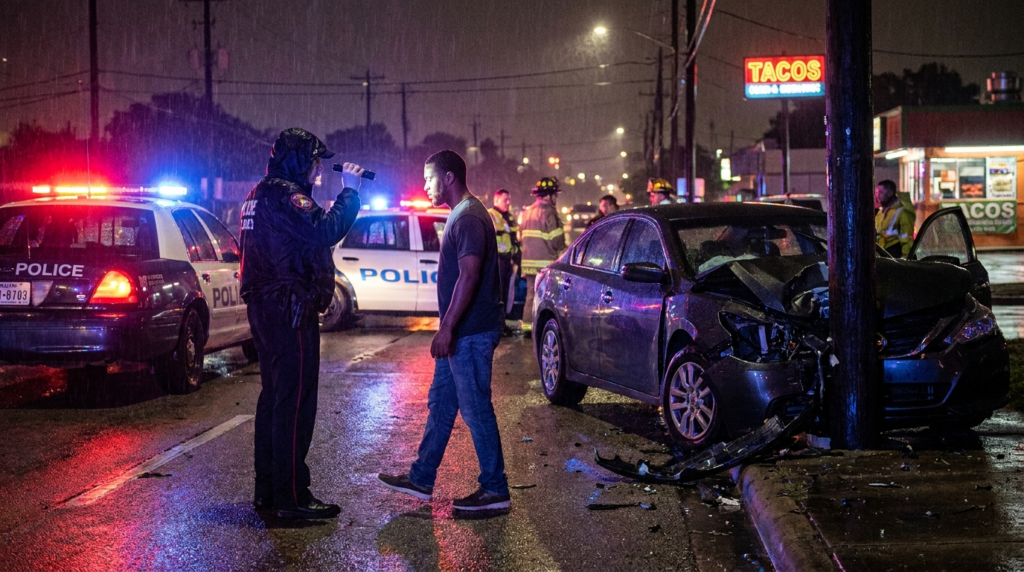
Being hit by a drunk driver is infuriating in a way that ordinary car accidents are not. Someone made a choice — a deliberate, reckless choice — to get behind the wheel impaired. According to the NHTSA, drunk driving kills nearly 10,000 people per year in the U.S. And now you’re dealing with the consequences: injuries, medical bills, missed work, and a car that may be totaled.
Here’s what you need to know: Texas law gives accident victims hit by drunk drivers stronger legal options than in typical crashes. That includes the possibility of punitive damages on top of your regular compensation. But those options depend entirely on how quickly and strategically you act.
Step 1: Make Sure the Police Are Called and the Driver Is Tested
The single most important thing that happens at the scene of a drunk driving accident is the police response. Officers can conduct field sobriety tests, request a breathalyzer, and — if they have probable cause — perform a blood draw. These results become critical evidence in both the criminal case against the driver and your civil lawsuit.
- Always call 911. Even if the other driver asks you to handle it privately, don’t. You have no way to verify their sobriety, insurance, or identity without a police report.
- Tell the dispatcher you suspect the driver is impaired. This ensures officers arrive expecting to conduct a DWI investigation, not just a routine accident report.
- Do not let the driver leave. Hit-and-run is a serious crime. If the driver tries to leave, note every detail you can: license plate, make, model, color, direction of travel.
Step 2: Document Everything You Can at the Scene
- Photograph both vehicles from multiple angles, including license plates
- Photograph the intersection, street signs, traffic signals, and skid marks
- Photograph your injuries immediately — bruising and swelling evolve over 24–72 hours, so photograph repeatedly
- Get names and contact information from every witness
- Note whether the driver smells of alcohol, seems unsteady, has slurred speech, or has open containers in the vehicle
- Ask responding officers for their badge numbers and the report number
Step 3: Get Medical Care Immediately
Adrenaline is a powerful painkiller. Many people involved in serious accidents feel surprisingly okay in the minutes after impact — and then discover significant injuries hours or days later. Whiplash, herniated discs, concussions, and internal bleeding can all be masked initially.
Go to the emergency room or urgent care the same day. Tell them you were in a car accident. This creates an immediate medical record linking your injuries to the crash — essential for your claim. Follow up consistently. Gaps in medical treatment are one of the most common tools insurance adjusters use to minimize claim value.
Understanding Your Legal Options: More Than a Standard Accident Claim
When a drunk driver hits you in Texas, you have two tracks running simultaneously: the driver’s criminal DWI case and your civil personal injury case. These are separate proceedings, but they interact in important ways.
Compensatory Damages
Like any car accident claim, you can seek compensation for medical bills (past and future), lost wages and reduced earning capacity, vehicle damage, pain and suffering, mental anguish, and loss of enjoyment of life.
Punitive (Exemplary) Damages
This is where drunk driving cases differ from typical accidents. Under Texas Civil Practice & Remedies Code Chapter 41, courts can award exemplary damages when a defendant acts with gross negligence or malice. Driving while intoxicated is almost universally treated as gross negligence in Texas civil courts. Punitive damages are separate from and in addition to your compensatory damages — designed to punish the defendant and deter others. In cases involving serious injuries and a driver with a prior DWI record, punitive awards can be substantial.
Dram Shop Liability
Texas’s Dram Shop Act (Texas Alcoholic Beverage Code §2.02) allows you to hold bars, restaurants, and social hosts liable if they served alcohol to a visibly intoxicated person who then caused an accident. This opens a second source of recovery — often with much deeper pockets than the individual driver. Surveillance footage at bars is typically overwritten within 30–60 days. Act quickly.

How the Criminal Case Affects Your Civil Claim
- A DWI conviction helps your civil case significantly. It establishes negligence per se — the driver’s illegal conduct is treated as automatic negligence.
- A plea deal or acquittal doesn’t end your civil case. Criminal cases require proof beyond a reasonable doubt. Civil cases use the lower “preponderance of evidence” standard.
- Criminal court records are powerful evidence. Blood test results, police dashcam footage, officer testimony, and field sobriety test records can be obtained and used in your civil proceedings.
What to Watch Out For: Insurance Company Tactics
Do not give a recorded statement to any insurance adjuster without first consulting an attorney. Common tactics to watch for include early settlement offers that don’t account for future medical costs, requests for blanket medical records authorizations, arguments that your injuries were pre-existing, and claims that you were partially at fault — even when the other driver was drunk.
Texas’s modified comparative fault rules mean your damages are reduced by your percentage of fault. Insurance adjusters will look for any way to assign fault to you.
Frequently Asked Questions
Yes. You can sue for both compensatory and punitive damages. A DWI conviction or arrest strengthens your civil case considerably, though you can pursue a lawsuit even without a criminal conviction.
Yes. Texas courts treat drunk driving as gross negligence, which opens the door to exemplary damages under Texas Civil Practice & Remedies Code Chapter 41.
Two years from the date of the accident under Texas’s statute of limitations. Act quickly — DWI-related evidence is time-sensitive, particularly bar surveillance footage.
No. You can file your civil lawsuit at any time within the two-year statute of limitations, regardless of where the criminal case stands.
Talk to a Houston Car Accident Attorney
Sources & Further Reading

Your Houston Personal Injury Attorney
BJ Kemp
Texas State Bar #24116608 · Texas Legal Giants · Houston, TX
Drunk driving crashes are among the most devastating — and most legally complex — cases BJ Kemp handles. Beyond suing the drunk driver, Texas’s Dram Shop Act (TABC § 2.02) creates liability for bars and restaurants that over-served them. He pursues every avenue of recovery, including punitive damages under CPRC § 41, to hold every responsible party accountable.
(346) 971–7333 — Free Case Review