
Quick Answer
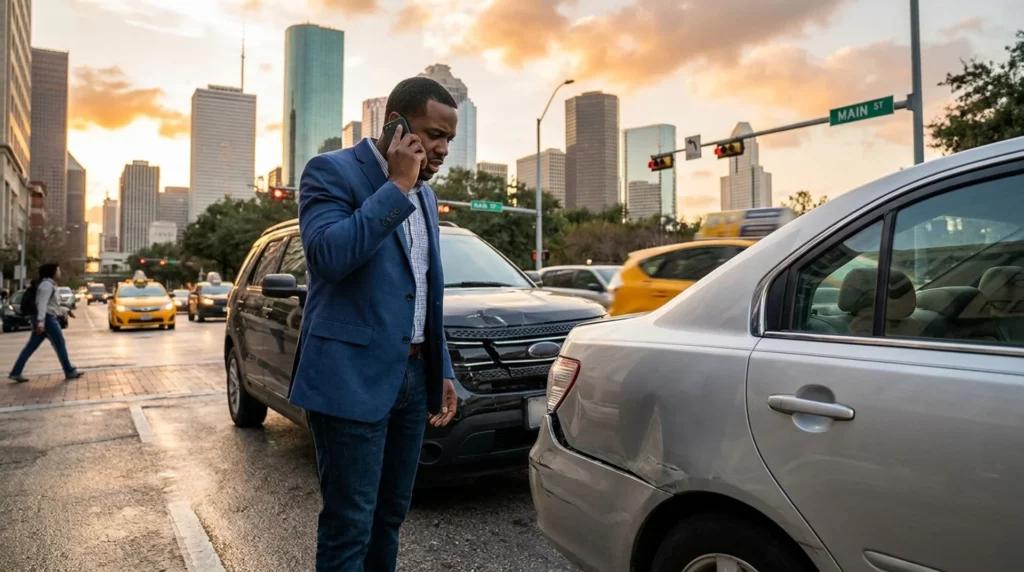
After a Houston car accident: move to safety → call 911 → document the scene before evidence disappears → exchange information (never admit fault) → see a doctor the same day → contact an attorney before signing anything. You have two years to file a lawsuit under Texas Civil Practice & Remedies Code §16.003, but critical evidence — traffic camera footage, EDR data — disappears in 24–72 hours.
A car accident can turn an ordinary Tuesday into one of the worst days of your life. In the seconds after impact, your mind races — Is everyone okay? What do I do next? The steps you take in the hours and days that follow can mean the difference between a full recovery and a dismissed claim. At Texas Legal Giants, Houston personal injury attorney BJ Kemp has guided hundreds of accident victims through exactly this situation. Here is the step-by-step guide he gives every client — updated for 2026 Texas law.
Harris County Traffic Fatalities per Year
Harris County consistently leads Texas in crash fatalities according to TxDOT crash data. Houston’s heavy commercial truck traffic, high population density, and aggressive driving culture make it one of the most dangerous metro areas in the nation for crashes.
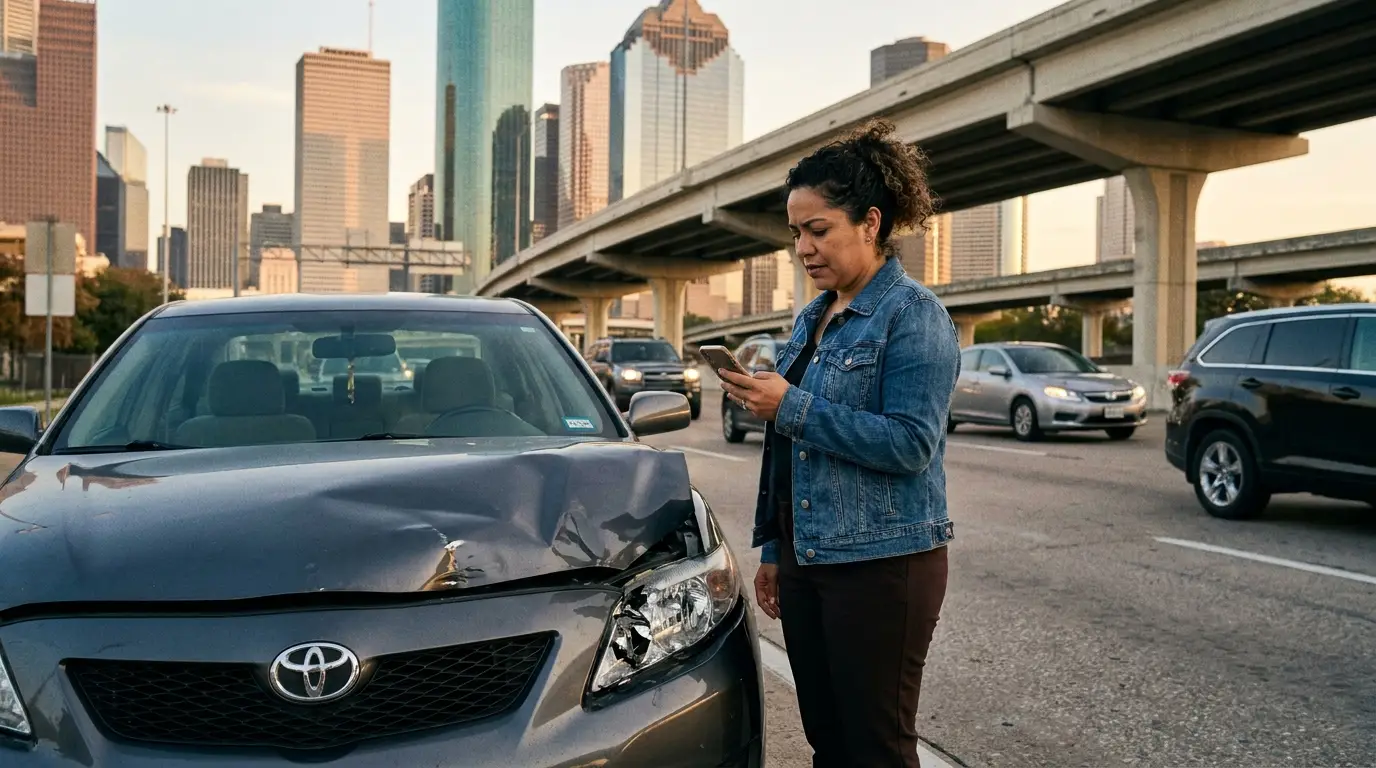
9 Steps to Take After a Houston Car Accident
Check for Injuries and Move to Safety
Check yourself and your passengers for injuries. If the vehicles are drivable and it is safe, move them to the shoulder or a nearby parking lot. Turn on hazard lights. Do not stand in traffic lanes — Harris County roads remain dangerous even after a crash.
Call 911
Call 911 even if the crash seems minor. Texas Transportation Code §550.021 requires you to remain at the scene of any accident involving injury, death, or property damage. §550.026 requires you to report any accident involving injury, death, or property damage over $1,000. Houston Police Department (HPD) or the Harris County Sheriff’s Office will respond and complete a Peace Officer’s Crash Report (CR-3) — the official record your insurance claim and any lawsuit will depend on.
Document the Scene — Before Evidence Disappears
While you wait for police, photograph and video everything:
- All vehicle damage — every angle, close-up and wide
- License plates of every vehicle involved
- Skid marks, debris field, and point of impact
- Traffic signals, signs, and road conditions
- Visible injuries on yourself or passengers
- Any dashcam footage — save it immediately before it overwrites
Exchange Information — Never Admit Fault
Get the other driver’s name, address, phone number, insurance company, policy number, driver’s license number, and license plate. Share the same in return.
Gather Witness Information
Ask any bystanders for their name and phone number before they leave. Independent witnesses — people with no stake in the outcome — carry significant weight with insurance adjusters and Harris County juries. In a disputed-fault case, a single credible witness can change the outcome entirely.
Seek Medical Attention the Same Day — Most Critical Step
Go to an emergency room, urgent care, or your physician the same day — even if you feel fine. Here’s why: adrenaline and shock suppress pain signals for hours after a crash. Whiplash, soft tissue injuries, and traumatic brain injury (TBI) symptoms typically peak at 12–48 hours after impact and can be completely absent at the scene. The 72-hour window matters. Insurance adjusters use gaps in medical treatment as their primary argument to deny or reduce claims. If you wait three days to see a doctor, the insurer will argue the injuries happened elsewhere. A medical record created within hours of the crash creates a direct, documented link between the accident and your injuries. Keep every appointment — physical therapy, specialist follow-ups, imaging. Every missed appointment is ammunition for the defense.
Notify Your Insurance Company
Report the accident to your own insurer promptly — most policies require timely notice as a condition of coverage. Stick to basic facts: date, location, vehicles involved. Do not give a recorded statement to any insurer — including your own — without speaking to an attorney first. Adjusters are trained to ask questions that minimize your claim. Politely say “I’ll have my attorney be in touch” and end the call.
Preserve All Evidence
Keep your damaged vehicle exactly as-is until it has been inspected — do not repair it. The damage is evidence. Save all medical bills, pharmacy receipts, and every out-of-pocket expense. Start a daily pain journal: a notes app entry each morning documenting your pain level (1–10), what you cannot do because of your injuries, and how your daily life is affected. This journal becomes powerful evidence for non-economic damages — pain and suffering, loss of enjoyment of life.
Contact a Houston Car Accident Attorney
Before you sign anything from an insurance company, consult a Houston car accident attorney. The other driver’s insurer will call quickly with a fast settlement offer — designed to close your claim before the full extent of your injuries is known. Once you sign, that’s final. An experienced attorney evaluates your case, handles all insurer communications, and negotiates from a position of strength. Most offer free consultations with no fee unless they win.
Free Consultation — No Fee Unless We Win
Injured in a Houston Car Accident?
BJ Kemp · Texas State Bar #24116608 · Available 24/7
Evidence That Disappears Fast After a Houston Crash
Most accident victims don’t realize how quickly critical evidence vanishes. By the time you’ve recovered enough to think about your claim, some of it may already be gone.
Traffic Camera Footage
City of Houston and TxDOT traffic cameras typically overwrite footage within 24–72 hours. An attorney can send a preservation demand to the City immediately to prevent this.
EDR / Black Box Data
Most modern vehicles have an Event Data Recorder (EDR) that captures speed, braking, and steering in the seconds before impact. This data is erased when the vehicle is repaired or totaled.
Business Surveillance Video
Nearby businesses — gas stations, restaurants, parking garages — often have cameras covering intersections. Most overwrite footage within 30–60 days, and businesses have no legal obligation to preserve it without a written request.
Cell Phone Records
If the other driver was texting or on a call at the time of impact, their carrier records prove it. Obtaining these requires legal process and must be requested before they are purged — typically after 18–24 months, but some carriers purge sooner.
A spoliation letter — a formal legal notice demanding preservation of evidence — is one of the first things a car accident attorney sends on your behalf. The longer you wait to hire counsel, the more of this evidence disappears permanently.
What If the Other Driver Has No Insurance?
Texas has one of the highest uninsured driver rates in the country. According to the Texas Department of Insurance, approximately 14% of Texas drivers carry no auto insurance at all — nearly 1 in 7 vehicles on Houston’s roads. If the at-fault driver is uninsured, you still have options.
Uninsured / Underinsured Motorist (UM/UIM) Coverage
Your own auto policy’s Uninsured Motorist (UM) or Underinsured Motorist (UIM) coverage kicks in to cover your damages when the at-fault driver has no insurance or insufficient coverage. Texas law requires insurers to offer UM/UIM coverage — you must reject it in writing to exclude it from your policy.
How it works:
- Uninsured Motorist (UM): Covers you when the at-fault driver has zero insurance, or in a hit-and-run where the driver flees.
- Underinsured Motorist (UIM): Covers the gap when the at-fault driver’s liability limits are too low to cover your full damages.
- UM/UIM also covers you as a pedestrian hit by an uninsured driver, and often as a passenger in another vehicle.
An attorney should review your full policy immediately after any accident involving an uninsured driver. UM/UIM claims have their own procedures, deadlines, and common insurer tactics — having counsel from the start prevents costly missteps. If you were struck by an uninsured driver, contact our Houston car accident team for a free case evaluation.
How to Get Your Houston Police Report (CR-3)
Every “what to do after a car accident” guide says to get the police report — but almost none explain how. Here are the exact steps for a Houston crash:
- Get the incident number at the scene. The responding HPD or Harris County Sheriff’s deputy will give you an 8-digit incident number. Write it down or photograph the officer’s card.
- Wait 5–10 business days. The formal CR-3 crash report is typically filed by the agency within this window.
- Request via TxDOT CRIS. Go to the TxDOT Crash Records Information System (CRIS) online. You can search by incident number, date, and location. The report costs $6 and can be downloaded immediately after purchase.
- Alternative — request directly from HPD. Submit an online report request through the Houston Police Department’s crash report portal. Processing takes 7–10 business days.
Texas Laws That Affect Your Case
Proportionate Responsibility — Civil Practice & Remedies Code §33.001
Texas uses a modified comparative fault system — officially called proportionate responsibility. You can recover damages as long as you are not more than 50% at fault for the accident. Your award is reduced by your percentage of fault.
Example: You are found 20% at fault. Your total damages are $100,000. Under §33.001, you recover $80,000 — reduced by your 20% share of responsibility.
This is why how you talk about the accident — starting at the scene — matters enormously. Never speculate about fault or apologize. Let the evidence and your attorney do the talking.
Statute of Limitations — Civil Practice & Remedies Code §16.003
In Texas, you have two years from the date of the accident to file a personal injury lawsuit. Miss this deadline and your claim is permanently barred, regardless of how serious your injuries are.
The Self-Reporting Rule — Transportation Code §550.026
If a peace officer does not respond to your accident and does not file a CR-3 report, you are legally required to file your own report with TxDOT within 10 days when the accident involved an injury or property damage over $1,000. This is a commonly overlooked requirement — particularly in minor crashes where HPD declines to respond. Filing ensures there is an official record of the accident, which your insurer and any future lawsuit will rely on.
Houston and Harris County Specifics
Harris County courts handle thousands of car accident cases each year. Special rules apply if your accident involved:
- Commercial trucks / 18-wheelers: Federal FMCSA regulations govern trucking companies. Evidence preservation notices must go out within 24–48 hours to prevent black box data from being erased.
- Rideshare vehicles (Uber/Lyft): Multiple insurance layers apply depending on the driver’s status at the time of the crash. Coverage disputes are common.
- Government vehicles: Claims against the City of Houston or Harris County require a formal notice of claim within 6 months — far shorter than the standard two-year limitation.
- Wrongful death: If a loved one was killed, the estate has two years to file, but evidence preservation must begin immediately.
Mistakes That Can Hurt Your Case
- Posting on social media. Insurance defense teams actively monitor claimants’ social media. A photo of you at a family dinner three days post-injury will be shown to a jury as evidence you weren’t seriously hurt. Pause all activity.
- Giving a recorded statement. You are not required to give one to the other driver’s insurer. Adjusters are trained to get you to say things that minimize your claim. Say you’ll have your attorney contact them.
- Skipping follow-up appointments. Every gap in your medical treatment is ammunition. Miss a physical therapy appointment and the insurer argues you aren’t actually injured.
- Accepting the first settlement offer. Initial offers are designed to close your file before the full extent of your injuries — and future medical costs — is clear. Once signed, it’s final.
- Repairing your vehicle too soon. Your car is physical evidence. Photograph every angle and have an expert inspect it before any repair work begins. Ideally, keep it until your attorney advises otherwise.
- Waiting too long to hire an attorney. Traffic camera footage, EDR data, and witness memories all deteriorate rapidly. The sooner counsel is involved, the more evidence can be preserved.
Frequently Asked Questions
Talk to a Houston Car Accident Attorney
Sources & Further Reading

Your Houston Car Accident Attorney
BJ Kemp
Texas State Bar #24116608 · Texas Legal Giants · Houston, TX
The hours immediately after a car accident are the most critical — and the most dangerous for your claim. BJ Kemp has seen insurers use delayed medical treatment and casual statements made at the scene to slash settlement offers. He moves fast to protect evidence and guide clients through exactly what to do from the moment the crash happens.