
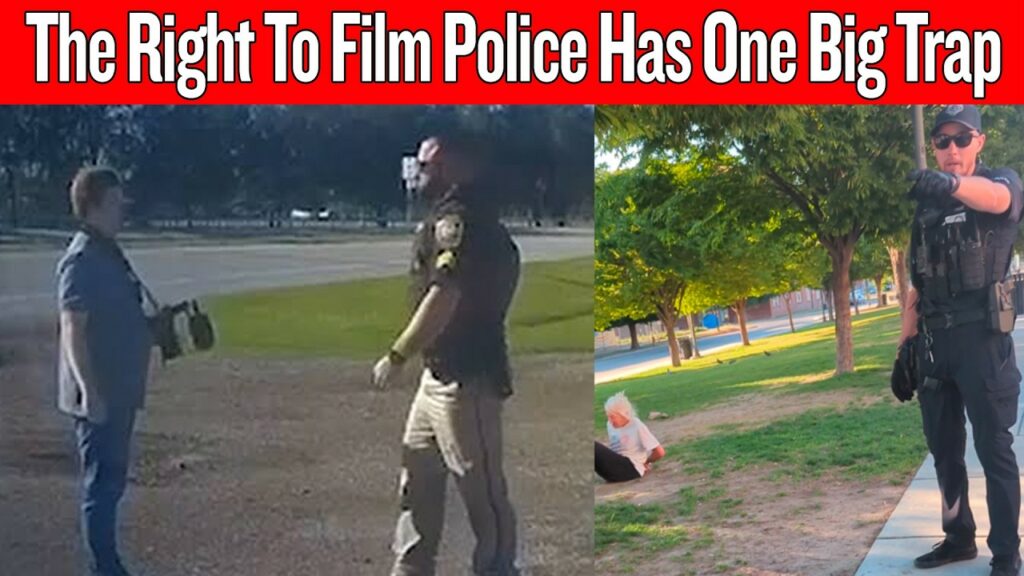
Filming a police officer performing public duties in Texas is a clearly established First Amendment right — the Fifth Circuit said so directly in Turner v. Driver in 2017. The trap is that one Texas statute, interference with public duties, gets charged anyway, and the moment you ignore a lawful order to step back you hand the officer the only fact that charge needs.
In Montgomery County, interference filings went from fewer than 30 in 2017 to more than 200 last year, and over 60% of those were dismissed — four years after that county’s own District Attorney put written guidance out telling officers that a person is free to watch and record an encounter. Here is the case that shows how the trap works, and how to stay out of it.
What Happened Outside That Conroe Home
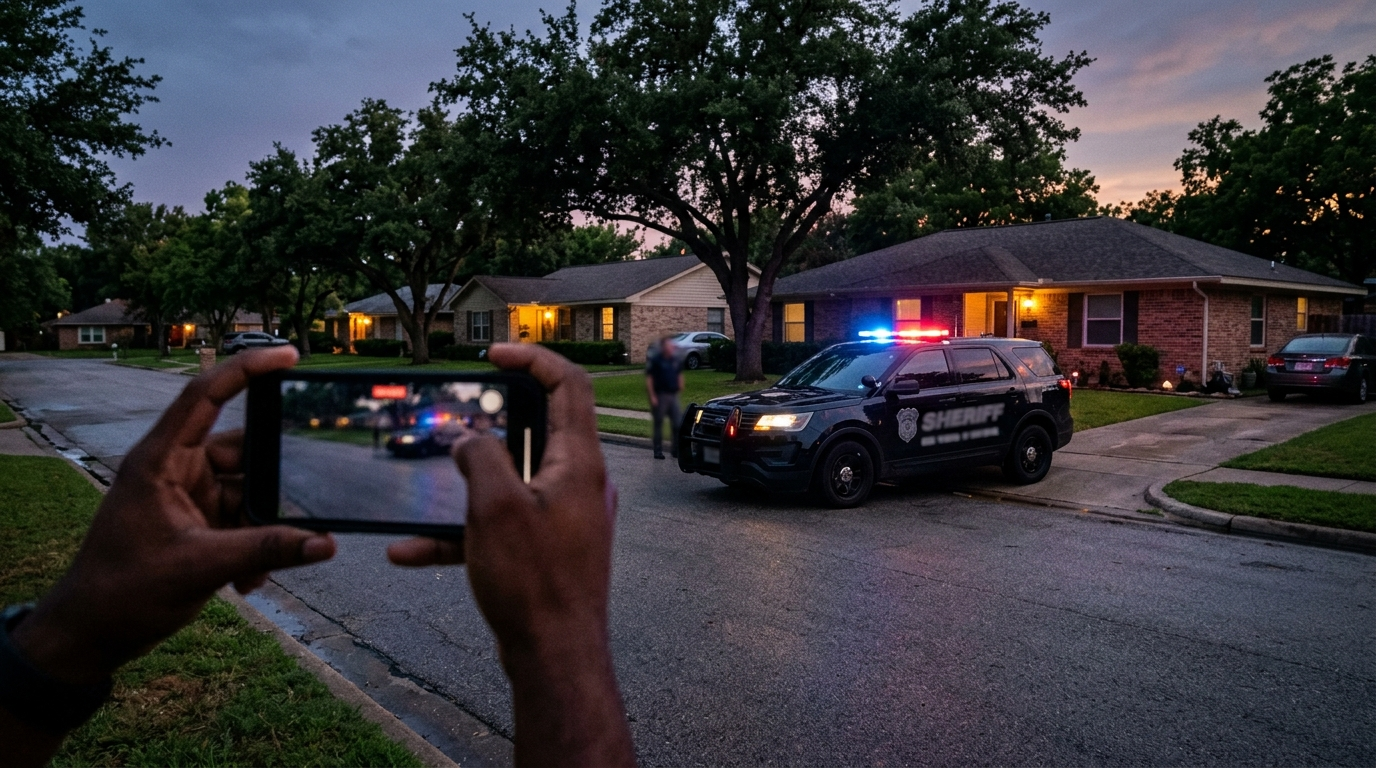
Body camera video obtained by KPRC shows Ismael Khan standing in his own front yard in Conroe, recording on his cell phone while a Montgomery County Sheriff’s deputy arrests his sister. Within seconds, Khan is on the ground in handcuffs himself. On the recording he asks the deputy why he was thrown to the ground. The deputy answers: “Because you’re under arrest — interfering with public duties.” Khan asks, “By taking a video?” The deputy says, “Yes.”
How the encounter started
According to the arrest report, Khan’s sister was driving a vehicle that came back as associated with a missing person — she had been reported missing days earlier. The deputy reported she failed to stop for more than two miles before pulling into her own driveway. Khan was not in the car. He came out of the house after his sister called him, and he says he started recording because he saw the deputy point a gun at her.
Both charges were dropped
Khan was charged with interference with public duties and resisting arrest. Both charges were dismissed. A former Montgomery County prosecutor, now a defense attorney, told the station plainly that Khan “certainly had a right to film” — while also acknowledging the deputy’s position: one officer, outnumbered, unsure whether the people around him were a threat. Both of those things can be true at once, and that is exactly why this charge keeps getting filed.
The Right Is Real, and It Is “Clearly Established”
In Turner v. Driver, 848 F.3d 678 (5th Cir. 2017), the federal appeals court that covers Texas, Louisiana, and Mississippi held that the First Amendment protects the right to record police performing their duties in public, subject to reasonable time, place, and manner restrictions. The court also held that this right became clearly established going forward — and that phrase carries real weight.

Why “clearly established” changes an officer’s exposure
Qualified immunity shields an officer from personal liability unless the right violated was clearly established at the time. Once the Fifth Circuit says a right is clearly established, an officer in Texas who arrests someone solely for recording is not merely mistaken — that officer can be personally liable under 42 U.S.C. § 1983, because the law says they should already have known better. The federal civil rights claim generally carries the same two-year deadline Texas applies to personal injury suits, so that clock starts the day you are arrested.
What the right does not cover
The right to record is not a right to position yourself anywhere you like. Officers can still give reasonable instructions — stand back, do not cross that line, do not block the driveway. Refusing a lawful order like that is a separate problem that has nothing to do with your camera, and it is where most people who are legally in the right end up in handcuffs anyway.
Were you arrested for recording the police?
Both of the charges in this story were dismissed. Find out what yours is worth. The first call is free.
(346) 971-7333 — Free Case ReviewThe Charge They Use: Penal Code § 38.15, and the Defense Written Into It
Texas Penal Code § 38.15(a)(1) makes it an offense to, with criminal negligence, interrupt, disrupt, impede, or otherwise interfere with a peace officer performing a duty. It is a Class B misdemeanor — up to 180 days in county jail and a $2,000 fine. Criminal negligence is the lowest culpable mental state in Texas law, which is precisely why this statute is so easy to charge and so hard to prove.

Subsection (d) is the whole ballgame
The statute contains its own built-in defense. Section 38.15(d): “It is a defense to prosecution under this section that the interruption, disruption, impediment, or interference alleged consisted of speech only.” Filming is not even speech — it is quieter than speech. A person standing at a distance holding a phone is not disrupting anything. That is a large part of why more than 60% of Montgomery County’s interference cases were dismissed.
The DA’s own 2021 guidance said the same thing
After watching interference filings climb, the Montgomery County District Attorney’s Office issued written guidance to law enforcement in 2021. To establish interference, the officer must show the person ignored repeated commands, actually impeded the officer’s duty, and did more than just talk. The guidance stated outright that a person is free to watch and record an encounter. Filings still went up, and so did dismissals. In the words of the former prosecutor interviewed for the story, that pattern “is indicative that the charge is probably being overused.”
What actually turns a lawful recording into a crime
- Physically stepping between an officer and the person being arrested. That is conduct, not speech, and § 38.15(d) will not reach it.
- Grabbing an officer’s arm, equipment, or the person being detained. Using force to prevent an arrest is resisting under § 38.03 — a Class A misdemeanor, and § 38.03(b) says it is no defense that the arrest itself was unlawful.
- Refusing a direct order to move back after being told once. This is the trap. The order is what converts your position from protected to chargeable, and it does so instantly.
- Walking away or pulling free once you are being detained. Evading detention under § 38.04 starts as a Class A misdemeanor and escalates fast.
How to Record an Encounter and Stay Out of Handcuffs
None of this is won on the sidewalk. It is won afterward, with the footage, in a courtroom. Your only job in the moment is to come away with the video and without a new charge.
Five rules for the moment itself
- Keep distance. Never stand close enough to touch anyone involved. Distance is the single fact that defeats “actually impeded.”
- If you are told to step back, step back immediately. Do not debate it. You can be completely right about your right to stand there and still be arrested for ignoring the order — and that arrest will stick better than the filming charge ever would.
- Say it once, calmly: “I’m recording and I’m not interfering.” Then stop talking. Lecturing an officer on case law in the middle of an arrest has never once helped anybody.
- Know what you must give. Under § 38.02, a person who is merely detained is not required to give a name — that duty attaches on lawful arrest. But a driver lawfully detained for an alleged violation must produce a driver’s license under § 38.02(b-1). Never give a false name to anyone under any circumstances.
- If they arrest you anyway, do not resist. Not physically, not by pulling away, not by walking off. Say “I want to speak to my attorney,” and stop talking.
What to do the next morning
Back up the video in two places before anything else — a phone in an evidence locker is a phone you do not control. Write down the date, the time, the agency, and every badge number you can recall. Then file a written request for the body camera footage, because the deputy’s own camera is usually the strongest witness you have, and retention windows are finite. A dismissal is not the end of it either: the arrest record itself can often be expunged, and if the only thing you did was hold a phone, there may be a § 1983 claim on top of it. BJ Kemp handles both sides of that, and the first call is free.
Frequently Asked Questions
Is it legal to film police in Texas?
Yes. In Turner v. Driver, 848 F.3d 678 (5th Cir. 2017), the federal appeals court covering Texas held that the First Amendment protects recording police performing their duties in public, and that the right is clearly established. It is subject to reasonable time, place, and manner limits — meaning an officer can lawfully tell you to step back, but cannot arrest you simply for holding a camera.
What is interference with public duties in Texas?
Texas Penal Code § 38.15(a)(1) makes it an offense to interrupt, disrupt, impede, or interfere with a peace officer’s duties with criminal negligence. It is a Class B misdemeanor carrying up to 180 days in county jail and a $2,000 fine. Subsection (d) provides a complete defense when the alleged interference consisted of speech only.
Can I be arrested just for recording a police officer?
It happens, and it is usually dismissed. In Montgomery County alone, interference filings rose from under 30 in 2017 to more than 200 last year, and over 60% of them were dismissed. The county’s own DA issued written guidance in 2021 stating that a person is free to watch and record an encounter, and that the charge requires proof the person ignored repeated commands and actually impeded the officer.
Do I have to give police my name if I am filming them in Texas?
Not if you are only being detained. Texas Penal Code § 38.02(a) requires you to give your name, address, and date of birth only after a lawful arrest. A driver lawfully detained for a violation must produce a license under § 38.02(b-1). Giving a false name is an offense in every one of those situations, so never do it.
Can I sue an officer who arrested me for filming?
Possibly. Because Turner v. Driver made the right clearly established in the Fifth Circuit, qualified immunity is harder for an officer to claim, and a federal civil rights claim under 42 U.S.C. § 1983 becomes viable. In Texas, that claim generally borrows the state’s two-year personal injury limitations period under Civil Practice and Remedies Code § 16.003, so the clock starts on the day of the arrest.
Sources & Further Reading

Your Houston Civil Rights and Criminal Defense Attorney
BJ Kemp
Texas State Bar #24116608 · Texas Legal Giants · Houston, TX
An interference charge is easy to file and hard to prove — which is why so many of them collapse. BJ Kemp gets the body camera footage preserved, pushes the speech-only defense in § 38.15(d), and looks at whether the arrest itself created a federal civil rights claim. Licensed in Texas and Michigan.
(346) 971–7333 — Free Case Review