
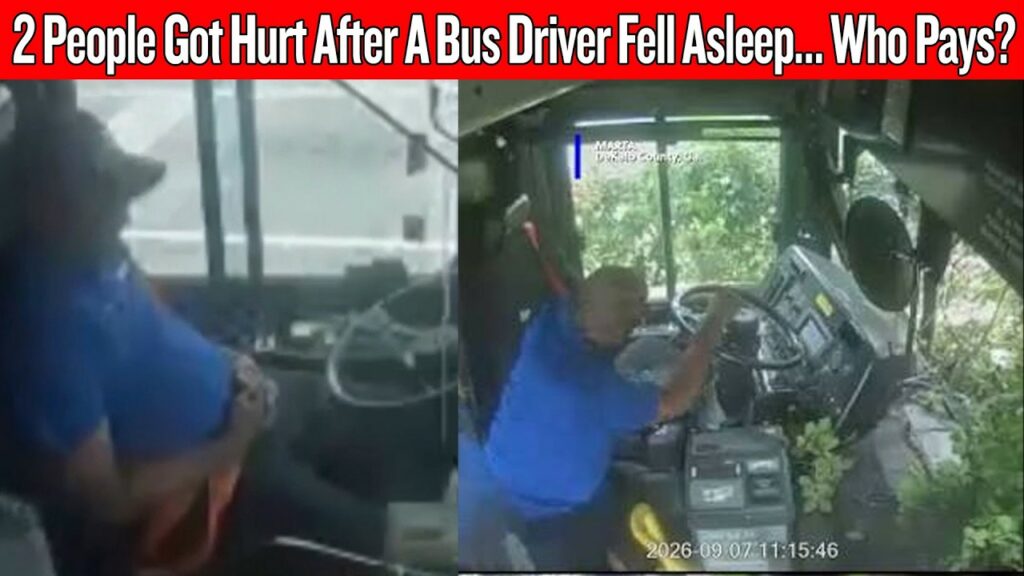
If a bus driver falls asleep and puts you in the hospital, the single fact that decides what your case is worth is not how badly you were hurt — it is who owns the bus. A private charter or shuttle company running a 16-passenger vehicle in interstate commerce must carry $5,000,000 in liability coverage. A regional transit authority is capped by statute at $100,000 per person, no matter what a jury thinks.
That is a 50-to-1 spread on identical injuries. Below is the crash that prompted the video, the reason the criminal charge is irrelevant to whether you get paid, and the deadline that quietly kills more of these claims than any defense lawyer ever does.
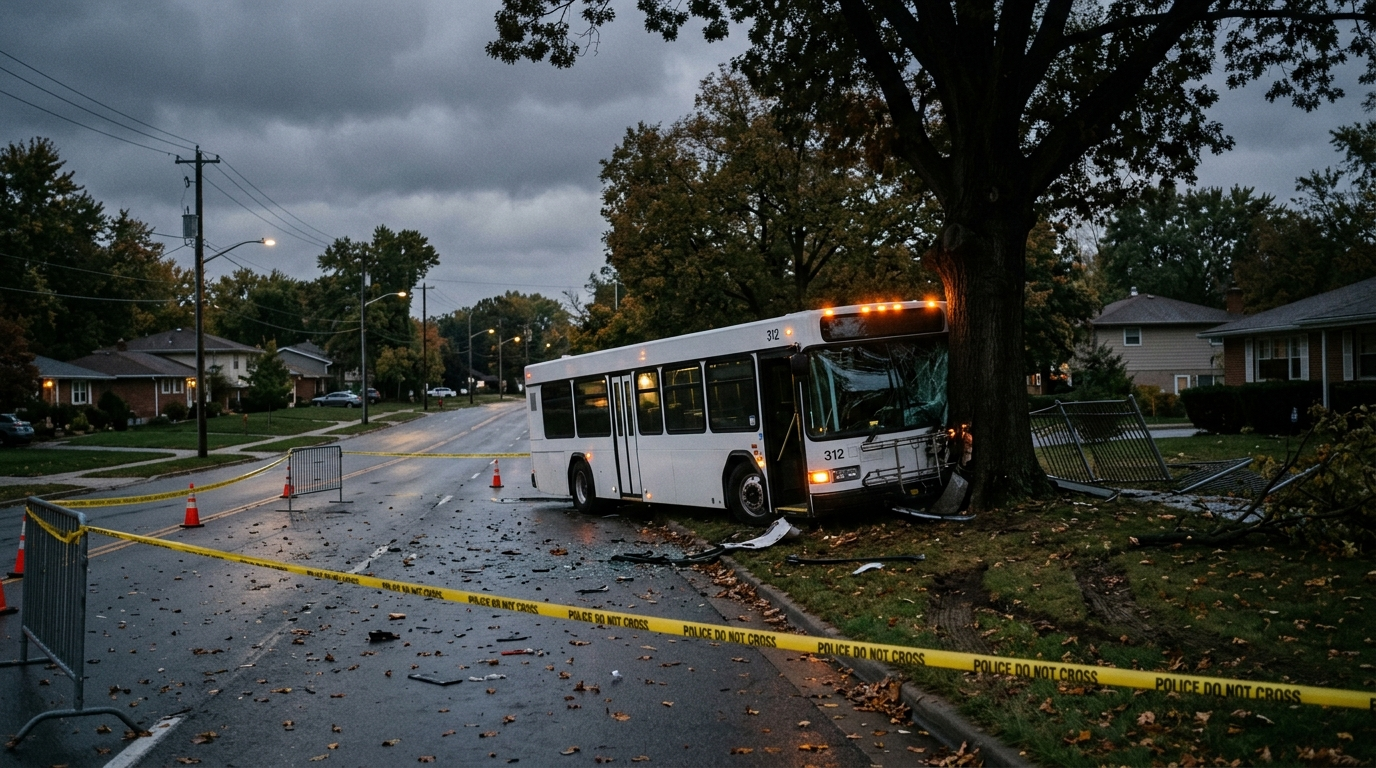
What Happened on That Bus — and What the Driver Was Actually Charged With
The footage in the video is onboard camera video from a MARTA transit bus in Dunwoody, Georgia. It shows the operator behind the wheel as the bus moves through an intersection, the driver’s body slumping, then the bus drifting into oncoming traffic and slamming into a tree near North Shallowford and Peachford roads. Two camera angles run at once — one on the driver, one on the cabin — and you can see a passenger thrown across the interior on impact.
Three people aboard, and a tree that landed on parked cars
Three people were on that bus: the driver and two passengers. Police reported that both passengers complained of injuries and the driver was transported to the hospital with visible, non-life-threatening injuries. The tree the bus struck came down on several parked vehicles, adding property damage claimants to the same incident. Hold that detail — it matters enormously later.
The driver was cited. He was not arrested.
Police charged the operator with distracted driving and failure to maintain the lane. No arrest. That result surprises people, and it should not. There is no Texas statute that makes falling asleep behind the wheel a crime. The equivalent Texas citation would come under Transportation Code § 545.060, failure to drive in a single marked lane. To get to reckless driving under § 545.401, the State would have to prove willful or wanton disregard for the safety of persons or property — a mental state, not a mistake. Ordinary negligence that hospitalizes two people usually is not a crime.
The Criminal Case Is Not Your Case — and a $30,000 Policy Is Not Either
This is the part injured passengers get wrong most often. A traffic ticket pays nothing. A criminal conviction pays nothing. Your claim is civil, it proceeds on its own track, and it does not care whether the driver was arrested, cited, or left alone at the scene. The civil question is negligence and damages; the criminal question is culpability. They are separate proceedings with separate standards of proof.

Why the insurance floor is the real story
Texas requires an ordinary driver to carry only 30/60/25 coverage — $30,000 per injured person, $60,000 per crash, $25,000 in property damage. That is the ceiling on most rear-end collisions, and it is why so many serious car-wreck claims collapse into a policy-limits fight. A for-hire passenger carrier is in a different universe. Under 49 C.F.R. § 387.33, a for-hire motor carrier of passengers operating in interstate commerce must carry $5,000,000 for any vehicle seating 16 or more including the driver, and $1,500,000 for vehicles seating 15 or fewer. That is not a payout. It is what exists to be fought over.
The driver’s logbook is often worth more than the crash report
A private carrier also has to keep hours-of-service records under federal safety regulations. Passenger-carrying drivers are limited to 10 hours of driving after 8 consecutive hours off duty and may not drive after 15 hours on duty. If the log shows the driver was over those hours, the case stops being about one man’s mistake and becomes a case against the company that put an exhausted person behind a 30,000-pound vehicle — negligent hiring, negligent supervision, and a corporate defendant with a $5 million policy behind it.
When the Government Owns the Bus, Every Number Changes
Sovereign immunity means a governmental unit cannot be sued unless it has agreed to be sued. In Texas that agreement is the Texas Tort Claims Act, and it is narrow. Section 101.021(1) waives immunity for personal injury or death proximately caused by an employee’s negligence that arises from the operation or use of a motor-driven vehicle. A driver falling asleep and crashing a bus is the textbook fact pattern that gets through that door.
What does not get through: DART v. Whitley
In Dallas Area Rapid Transit v. Whitley, 104 S.W.3d 540 (Tex. 2003), a passenger claimed a DART operator put him off the bus in a dangerous area and failed to protect him. The Texas Supreme Court held that was not use of the bus — it was a failure to supervise or protect, which the Act does not cover. Immunity was never waived and the case ended. The lesson is precise: the injury has to come out of the vehicle’s operation itself, not out of a decision the operator made.
The $100,000 ceiling almost nobody riding the bus knows about
Section 101.023 caps recovery, and the tier depends on the defendant. Against the state or a municipality: $250,000 per person and $500,000 per single occurrence. Against any other unit of local government — which is generally how regional transit authorities such as Houston’s METRO are treated — it drops to $100,000 per person and $300,000 per occurrence, with $100,000 for all property damage. Section 101.024 bars exemplary damages entirely.
Now go back to the crash. Two injured passengers, an injured driver, and several crushed parked cars may all be splitting one $300,000 occurrence cap and one $100,000 property pot. On the private-carrier side of that same line sits $5 million. Same injuries, same impact, different owner.
Were you hurt on a bus in Houston?
Find out who owns it and which deadline applies before you lose either one. The first call is free.
(346) 971-7333 — Free Case ReviewThe 90-Day Deadline That Ends These Cases Before They Start
Section 101.101(a) entitles a governmental unit to written notice of your claim no later than six months after the incident, and that notice must reasonably describe the injury claimed, the time and place, and the incident itself. Six months sounds generous. It usually is not the deadline that applies.

City charters are allowed to shorten it, and Houston’s does
Section 101.101(b) ratifies and approves a city charter’s own notice provision. Houston’s charter requires written, sworn notice within 90 days, with specific required content: when it happened, where, how, the nature of the injury, the extent of the injury, and the witnesses. Meanwhile the general statute of limitations for personal injury is two years under Civil Practice and Remedies Code § 16.003. So people heal, negotiate with an insurer, call a lawyer at month eight, and discover the claim died at day 91 — not under the statute of limitations they had heard of, but under a city charter they had never heard of.
Do not rely on “they already knew about it”
Section 101.101(c) contains an actual-notice exception, and the Texas Supreme Court narrowed it hard in Worsdale v. City of Killeen, 578 S.W.3d 57 (Tex. 2019). Actual notice requires the governmental unit to be subjectively aware of its own fault in producing or contributing to the claimed injury — not merely aware that a crash occurred. A police report generated at the scene, standing alone, is generally not enough. Assume you owe formal written notice and file it.
Six Things to Do If You Were on That Bus
- Get evaluated the same day, even if you feel fine. Adrenaline masks soft-tissue and head injuries for hours. A gap in treatment is the first thing an adjuster uses to argue you were not really hurt.
- Capture what disappears before you leave. Photograph the interior and exterior, and record the bus number, the route, and the time. Get the name and phone number of every other passenger — witnesses on a public bus scatter within minutes and are essentially never located again.
- Demand preservation of the onboard video in writing, immediately. The footage in this story exists because buses are covered in cameras — and those systems overwrite themselves, sometimes within a few weeks. A written spoliation letter covering the video, the vehicle data recorder, and the driver’s hours has to go out right away.
- Do not give a recorded statement or sign a blanket medical authorization. Report the incident, get the report number, and stop. A blanket release hands them a decade of your medical history to mine for “pre-existing” conditions.
- Assume 90 days, not six months. File formal written notice early and correctly, and treat the shorter charter deadline as the real one until someone confirms otherwise in writing.
- Find out who owns the bus before you accept anything. Private carrier or governmental unit changes the ceiling, the deadline, and the entire value of the claim.
Where to get that answered quickly
Ownership is usually resolvable in a single afternoon — a commercial vehicle claim against a charter company and a Tort Claims Act claim against METRO look nothing alike from day one, and you cannot afford to guess for three months. If you were hurt on any bus in the Houston area, talk to a lawyer before the video is overwritten. Texas Legal Giants takes that call for free.
Frequently Asked Questions
How much insurance does a bus company have to carry in Texas?
A for-hire motor carrier of passengers operating in interstate commerce must carry $5,000,000 in public liability coverage for any vehicle seating 16 or more people including the driver, and $1,500,000 for vehicles seating 15 or fewer, under 49 C.F.R. § 387.33. By comparison, Texas requires an ordinary driver to carry only 30/60/25 — $30,000 per person.
Can I sue METRO or a city bus system in Texas?
Yes, but only through the narrow waiver in the Texas Tort Claims Act. Civil Practice and Remedies Code § 101.021(1) waives immunity for injuries arising from a government employee’s negligent operation or use of a motor-driven vehicle, which covers a driver falling asleep and crashing. It does not cover a failure to supervise or protect — see Dallas Area Rapid Transit v. Whitley, 104 S.W.3d 540 (Tex. 2003).
What is the maximum I can recover from a government bus crash in Texas?
Section 101.023 caps it. Against the state or a municipality: $250,000 per person and $500,000 per single occurrence. Against any other unit of local government, including most regional transit authorities: $100,000 per person and $300,000 per occurrence, plus $100,000 total for property damage. Section 101.024 prohibits exemplary damages in every case.
How long do I have to file a claim after a city bus accident in Houston?
Assume 90 days. Civil Practice and Remedies Code § 101.101(a) sets a six-month written notice requirement, but § 101.101(b) ratifies shorter city charter deadlines, and Houston’s charter requires sworn written notice within 90 days with specific required content. The separate two-year statute of limitations under § 16.003 does not save you if you miss the notice.
Does the bus driver have to be arrested for me to get paid?
No. The criminal case and your civil claim are entirely separate. In this crash the driver was cited for distracted driving and failure to maintain the lane and was never arrested — there is no Texas statute making falling asleep at the wheel a crime, and reckless driving under Transportation Code § 545.401 requires willful or wanton disregard. A ticket pays none of your medical bills either way.
Sources & Further Reading
- Texas Civil Practice & Remedies Code Chapter 101 — Texas Tort Claims Act
- Texas Civil Practice & Remedies Code § 16.003 — Two-Year Limitations Period
- Texas Transportation Code Chapter 545 — Operation and Movement of Vehicles
- 49 C.F.R. § 387.33 — Financial Responsibility, Minimum Levels
- FMCSA — Hours of Service Regulations

Your Houston Bus Accident Attorney
BJ Kemp
Texas State Bar #24116608 · Texas Legal Giants · Houston, TX
Bus cases are won or lost in the first 90 days, before most people have finished physical therapy. BJ Kemp identifies who owns the vehicle, files the notice the charter actually requires, and gets a preservation demand out before the onboard video overwrites itself. If you were hurt on a bus in Houston, the clock is already running.
(346) 971–7333 — Free Case Review