
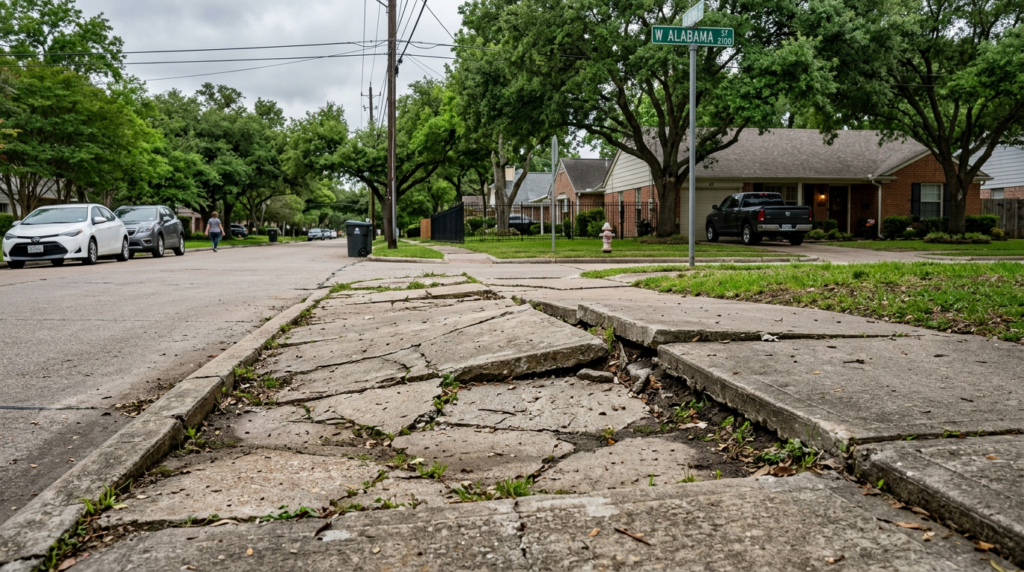
Yes — you can sue the City of Houston for a sidewalk fall, but only under the strict conditions of the Texas Tort Claims Act (TTCA). Texas law generally shields governments from lawsuits, but Tex. Civ. Prac. & Rem. Code §101.021 creates a specific exception when a city’s negligent maintenance of public property — including sidewalks — causes personal injury.
The Texas Tort Claims Act §101.021 — How It Opens a Path to Suing Houston
The TTCA waives the City of Houston’s sovereign immunity for injuries caused by the condition of tangible real property the city owns or controls. Public sidewalks qualify. But the waiver is narrow: falling on city property alone is not enough. You must prove the city negligently maintained the sidewalk and that negligence caused your injury.
Texas law distinguishes two categories of sidewalk defects with different legal standards:
- Special defects (§101.022(b)): Excavations, sudden obstructions, or conditions equivalent to road hazards — such as a severely raised or collapsed panel. The city owes you the same full duty of care as a private landowner.
- Premise defects (§101.022(a)): General deterioration like settled or cracked pavement. The city only owes the lower duty owed to a licensee — meaning you must prove the city had actual knowledge of the specific hazard, not just that it was visible.
Which category applies to your fall can determine whether you win or lose. An experienced Houston slip and fall attorney can assess the defect and frame the claim correctly.
The 6-Month Written Notice Requirement Under §101.101 — Miss It, Lose Your Claim
Before you can file any lawsuit against the City of Houston, you must serve formal written notice of your claim within 6 months of the incident under §101.101 of the TTCA. This notice must include:
- The exact date, time, and location of your fall
- A description of your injuries
- The facts giving rise to your claim
Notice must be delivered to the City of Houston Legal Department in writing. A 311 service request, 911 call, or incident report is typically not sufficient as formal §101.101 notice. Courts have dismissed valid injury claims solely because the plaintiff missed this 6-month window. There is a narrow exception when the city had “actual notice,” but Texas courts apply it sparingly — do not count on it.
Damage Caps: §101.023 Limits City Liability to $100,000 Per Person
Even if you prove every element of your claim, §101.023 caps personal injury damages against Texas municipalities at $100,000 per person and $300,000 per single occurrence. Unlike claims against private landowners — where there is no statutory cap — your maximum recovery from the City of Houston is fixed by law regardless of injury severity.
Free Case Evaluation
Hurt on a Houston City Sidewalk?
BJ Kemp helps Houston families navigate the Texas Tort Claims Act and hold the city accountable. The 6-month notice deadline comes faster than you expect — call now.
(346) 971–7333 — Free ConsultationProving the City Had Notice — 4 Types of Evidence That Build These Cases
Whether your claim involves a special or premise defect, you must show the city knew — or should have known — the sidewalk was dangerous and failed to repair it in a reasonable time. The strongest evidence:
- 311 complaint records: Prior service requests documenting the same hazard before your fall — obtainable through your attorney’s public records requests.
- City inspection and maintenance logs: Records showing the defect was observed but left unrepaired — often accessible only through attorney subpoena.
- Duration of the defect: A crack that has widened and deteriorated for 18+ months is strong constructive notice evidence.
- Photographs taken immediately after the fall: Document the defect’s size and severity, missing repair markings, surrounding conditions, and lighting.
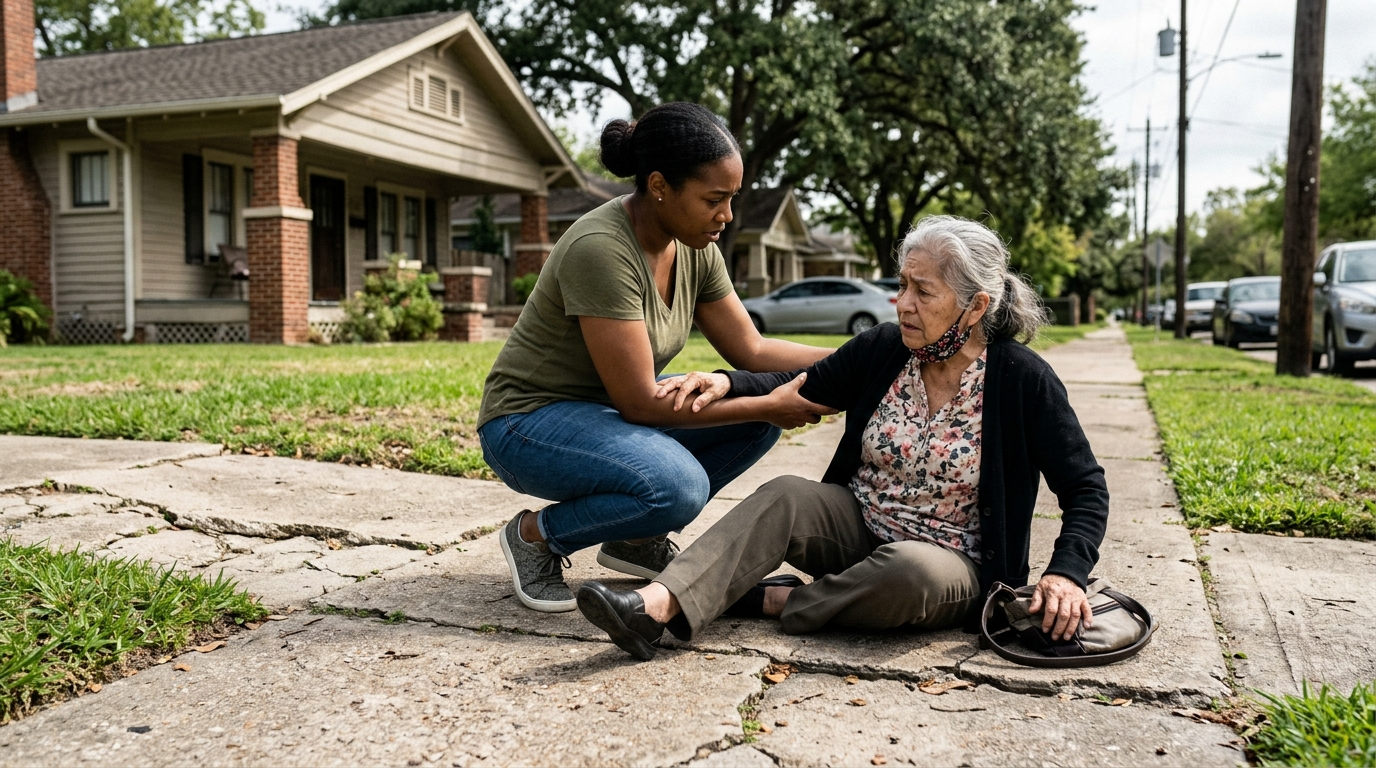
The 2-Year Statute of Limitations — §16.003 Is Your Outside Deadline
Separate from the 6-month notice requirement, Tex. Civ. Prac. & Rem. Code §16.003 gives you 2 years from the date of your fall to file a lawsuit. Both deadlines run independently and must both be satisfied. Contact a Houston personal injury attorney as soon as possible — treatment, recovery, and insurance talks can consume months before you realize the clock is nearly up.
What a Houston City Sidewalk Fall Case Is Realistically Worth
City sidewalk claims typically settle below the statutory cap because Houston contests liability aggressively. Realistic ranges:
- Soft tissue injuries (sprains, bruising, no surgery): $8,000–$25,000
- Fractures (wrist, ankle, hip, knee): $30,000–$75,000
- Surgery or permanent impairment: $75,000–$100,000 (approaching the §101.023 cap)
Recoverable damages include past and future medical expenses, lost wages, pain and suffering, and future care costs. Cases where the hazard was documented repeatedly and ignored by the city sometimes reach the full $100,000 per-person cap.

Frequently Asked Questions
Under Tex. Civ. Prac. & Rem. Code §101.101, you must deliver written notice of your claim to the City of Houston within 6 months of the incident. The notice must state the date, time, location, and nature of your injuries. Missing this deadline can permanently bar your claim even if the city was clearly at fault.
The Texas Tort Claims Act caps personal injury damages against Texas municipalities at $100,000 per person and $300,000 per occurrence under §101.023. No matter how severe your injuries, you cannot recover more than these amounts from the City of Houston in a TTCA claim.
A special defect under §101.022(b) is an excavation, obstruction, or sudden hazard — such as a severely raised or collapsed sidewalk panel that creates an unexpected tripping danger. For special defects, the city owes you the same full duty of care as a private landowner, which is a higher legal standard than for ordinary premise defects.
You have 2 years from the date of the fall to file a lawsuit under Tex. Civ. Prac. & Rem. Code §16.003. This is separate from the 6-month notice requirement — both must be met. Failing either one can defeat your claim entirely.
Yes. Under the Texas Tort Claims Act, the city must maintain public sidewalks in reasonably safe condition. You must prove the city had actual or constructive notice of the defect — meaning it existed long enough that the city should have discovered and repaired it — and failed to act within a reasonable time.
Sources & Further Reading

Your Houston Slip & Fall Attorney
BJ Kemp
Texas State Bar #24116608 · Texas Legal Giants · Houston, TX
BJ Kemp has navigated Texas Tort Claims Act cases against the City of Houston and knows the procedural traps that sink otherwise valid claims — including the 6-month notice requirement that catches many injured Houstonians off guard. His firm works on contingency, so you pay nothing unless you win.
(346) 971–7333 — Free Case Review