
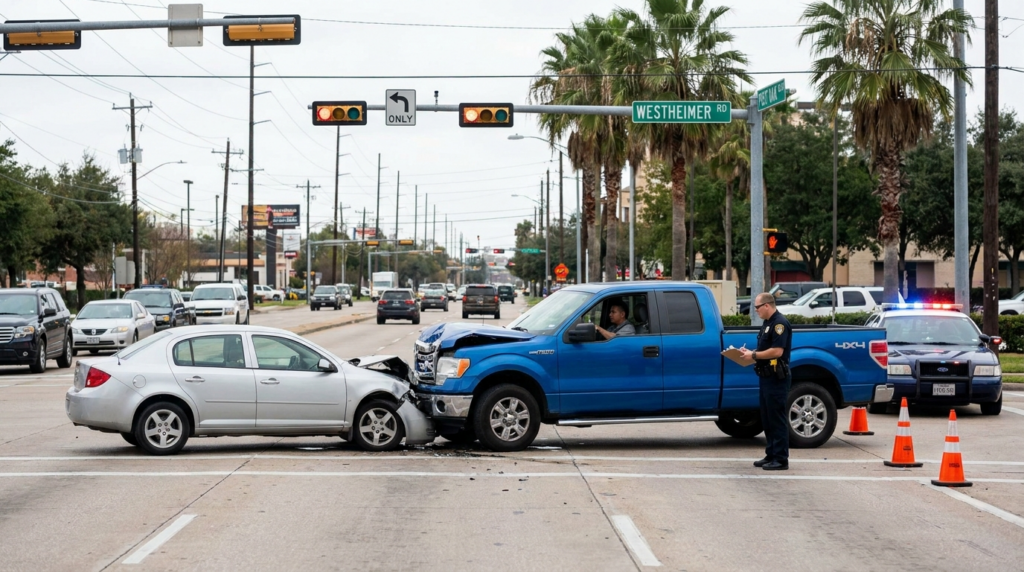
One of the first things insurance adjusters do after a Texas car accident is try to assign you a percentage of fault. Even if the other driver blew a red light, they’ll look for anything to pin on you — you were 5 mph over the speed limit, you didn’t brake fast enough, you were distracted. Every percentage point they assign to you is a percentage point they don’t have to pay.
Understanding Texas comparative fault law is essential to protecting your claim. The good news: even if you share some responsibility for the accident, you may still be entitled to significant compensation.
Texas Modified Comparative Fault: The 51% Bar Rule
Texas follows modified comparative fault, codified in Texas Civil Practice and Remedies Code Section 33.001. The law works as follows:
- Your total damages are calculated
- A fault percentage is assigned to each party
- Your recovery is reduced by your percentage of fault
- If your fault exceeds 50%, you recover nothing
This is called the 51% bar rule — if you are found 51% or more responsible for the accident, you are barred from any recovery. If you are 50% or less at fault, you can still recover, but your award is reduced proportionally.
The practical implication: fault assignment is not just an academic exercise. Every percentage point matters. The difference between 50% and 51% at fault is the difference between recovering half your damages and recovering nothing.
How Fault Percentages Are Assigned
Fault percentages don’t come from a formula — they’re the product of negotiation, evidence interpretation, and (in litigated cases) jury determination. Here’s how the process works:
The Insurance Adjuster’s Initial Assignment
After reviewing the police report, statements from both drivers, photos, and other initial evidence, the at-fault driver’s insurer will assign fault percentages. This is their opening position — not a neutral finding. Adjusters are trained to maximize your assigned fault percentage, which directly reduces what their company pays.
Negotiation Between Attorneys
When attorneys are involved, they challenge the initial fault assignment by presenting additional evidence, expert analysis, and legal arguments. Many cases are resolved through negotiation without litigation, with fault percentages shifting significantly during the process.
Jury Determination at Trial
If a case goes to trial, the jury answers specific questions about each party’s negligence and assigns fault percentages on a special verdict form. Texas juries can also assign fault to non-parties (like a road designer or vehicle manufacturer) if evidence supports it, which can reduce the at-fault driver’s assigned percentage — or the plaintiff’s.
Real Examples: How Comparative Fault Affects Your Recovery
Let’s make this concrete with some scenarios common to Houston roads:
Scenario 1: Highway Rear-End on I-10
You were rear-ended on I-10 near Katy. The at-fault driver claims you braked suddenly without cause. Your total damages: $80,000. The insurer argues you were 20% at fault for the sudden stop.
Result: If the 20% assignment holds, you recover $64,000 (80% of $80,000). An attorney challenges it with dashcam footage and witness statements, reduces your fault to 5%, and you recover $76,000 instead.
Scenario 2: Intersection Collision on Westheimer
You entered an intersection as the light turned yellow. The other driver ran a clearly red light. They argue you should have stopped. Total damages: $120,000. Insurer assigns you 15% fault.
Result: Your attorney obtains the intersection camera footage proving the light timing, reduces your fault to 0%, and you recover the full $120,000.
Scenario 3: Multi-Car Pileup on Beltway 8
Three cars are involved. Driver A hits Driver B, who then hits you. Fault is split: Driver A at 60%, Driver B at 30%, you at 10%. Your damages: $200,000.
Result: You recover $180,000 (90% of your damages, reflecting your 10% fault). Under Texas law, you can collect proportional amounts from Driver A’s and Driver B’s insurers.

How Insurance Companies Use Comparative Fault Against You
Comparative fault is one of insurance companies’ most powerful weapons. Here are the specific tactics they use:
Inflating Your Fault Percentage
Adjusters are trained to find anything you did that contributed to the accident and weight it heavily. Were you going 3 mph over the speed limit? Were you unfamiliar with the road? Had you driven through that intersection many times without incident? Each of these becomes a basis for assigning you more fault.
Getting You to Admit Fault
Recorded statements are designed in part to capture anything that sounds like an admission. “I didn’t have much time to react” sounds like a description of events. To an adjuster, it’s a concession that you could have reacted faster. “I was going with traffic” might acknowledge you were exceeding the speed limit.
Using Your Own Insurance Company’s Statements
When you file a claim with your own insurer, that information can sometimes be used by the at-fault driver’s insurer. Anything you say during any claim process about the accident needs to be carefully considered.
Arguing Pre-Impact Conduct
Insurers look for conduct before the actual collision — distracted driving, lane changes, speed — to assign you fault even when the immediate cause of the accident was clearly the other driver’s negligence.
Proving the Other Driver Was More at Fault
Minimizing your assigned fault percentage requires building a strong evidentiary case for the other driver’s negligence. Key evidence includes:
- Police report: If the officer cited the other driver or noted they were at fault, this is powerful initial evidence — though not conclusive.
- Traffic and surveillance camera footage: Houston and Harris County have extensive camera networks. Your attorney can subpoena footage from TxDOT, the city, and nearby businesses before it’s overwritten (often within 30–90 days).
- Dashcam video: Your dashcam or the other vehicle’s dashcam footage can be decisive. This evidence must be preserved immediately.
- Witness statements: Independent witnesses who have no stake in the outcome carry significant weight with adjusters and juries.
- Accident reconstruction: Expert accident reconstructionists can analyze skid marks, vehicle damage patterns, and physics to determine speeds, points of impact, and who had the right of way.
- Cell phone records: If the other driver was distracted, their cell records can prove it. This requires legal process to obtain.
- Traffic violation history: A pattern of violations by the at-fault driver is relevant to establishing negligence.
Evidence That Shifts Fault Percentages
Beyond the basics, certain types of evidence are particularly effective at shifting fault assignments in Texas cases:
- Black box (EDR) data: Most modern vehicles have Event Data Recorders that capture speed, braking, and acceleration in the seconds before a crash. Downloading and preserving this data requires quick action — it can be overwritten in subsequent accidents.
- Toxicology results: If the at-fault driver was impaired, this dramatically increases their fault percentage and may support punitive damages.
- Traffic signal timing records: In intersection crashes, the actual signal timing at the moment of impact can be obtained from TxDOT or the municipality. Signal malfunction can also be a factor.
- Roadway condition documentation: Potholes, missing signage, or poorly designed intersections can shift fault to governmental entities, reducing what’s assigned to either driver.
What Happens If You’re 50% at Fault vs. 51% at Fault
This is the most consequential line in Texas personal injury law. The difference is stark:
- 50% at fault: You recover 50% of your total damages. On a $200,000 case, that’s $100,000.
- 51% at fault: You recover $0. The same $200,000 in damages yields nothing.
This is why cases where fault is genuinely disputed — and particularly cases hovering around the 50% mark — require aggressive legal representation. The insurer has every incentive to push your fault from 49% to 51%. Your attorney has every incentive to push it the other direction.
In a jury trial, this single question can be the difference between a life-changing recovery and nothing at all. Jury selection, witness presentation, and closing argument all shape how jurors assign fault percentages.
Working with an Attorney to Minimize Your Fault Assignment
An experienced personal injury attorney addresses comparative fault from the moment they take your case. Specifically:
- Early evidence preservation: Sending a preservation letter immediately to the at-fault driver, their insurer, and relevant government agencies to preserve all evidence before it disappears
- Controlling your narrative: Advising you not to give recorded statements and managing all communications with the insurer
- Independent investigation: Interviewing witnesses, obtaining camera footage, and engaging accident reconstruction experts before evidence is lost
- Expert testimony: Lining up credible experts — accident reconstructionists, biomechanical engineers, medical experts — who can testify about fault and causation
- Aggressive negotiation: Challenging initial fault assignments with documented evidence rather than accepting the insurer’s first position
- Trial preparation: If the case doesn’t settle, presenting the evidence in the most compelling way to a jury
At Texas Legal Giants, BJ Kemp handles comparative fault disputes throughout the Houston area, including cases on I-10, I-45, I-69, Beltway 8, and the 610 Loop — some of the busiest and most accident-prone roads in the country. He knows how to build the evidence necessary to minimize your assigned fault and maximize your recovery.
Frequently Asked Questions
Texas uses modified comparative fault under Texas Civil Practice and Remedies Code Section 33.001. You can recover damages if your fault is 50% or less, but your recovery is reduced by your fault percentage. At 51% or more at fault, you recover nothing.
Yes. If your fault is 50% or less, you recover your damages reduced by your fault percentage. At 30% fault with $100,000 in damages, you would recover $70,000.
Through negotiation between attorneys and insurers, or by a jury at trial. The police report, camera footage, witness statements, accident reconstruction, and expert testimony all shape fault assignments. Initial adjuster assignments can and should be challenged with evidence.
Both can potentially recover, reduced by their respective fault percentages, as long as neither is more than 50% responsible. In practice, the party with higher fault usually ends up being the net payer through their insurer.
Absolutely. Adjuster assignments are opening positions, not legal rulings. An attorney can challenge them with additional evidence, expert analysis, and legal argument — often successfully reducing the percentage assigned to you.
Talk to a Houston Car Accident Attorney — Free Consultation
Sources & Further Reading

Your Houston Car Accident Attorney
BJ Kemp
Texas State Bar #24116608 · Texas Legal Giants · Houston, TX
Texas’s modified comparative fault rule means even partial fault doesn’t bar your claim — as long as you’re 50% or less responsible. BJ Kemp aggressively challenges fault assignments that insurers use to reduce payouts. He builds the evidence to show the other party’s negligence was the dominant cause of the crash and your injuries.