
A traffic stop in Texas is legal only for as long as the traffic ticket reasonably takes — and not one minute longer. That is not an opinion, it is the holding of Rodriguez v. United States, decided by the Supreme Court in 2015, and it is the only question that actually decides whether a stop was constitutional.
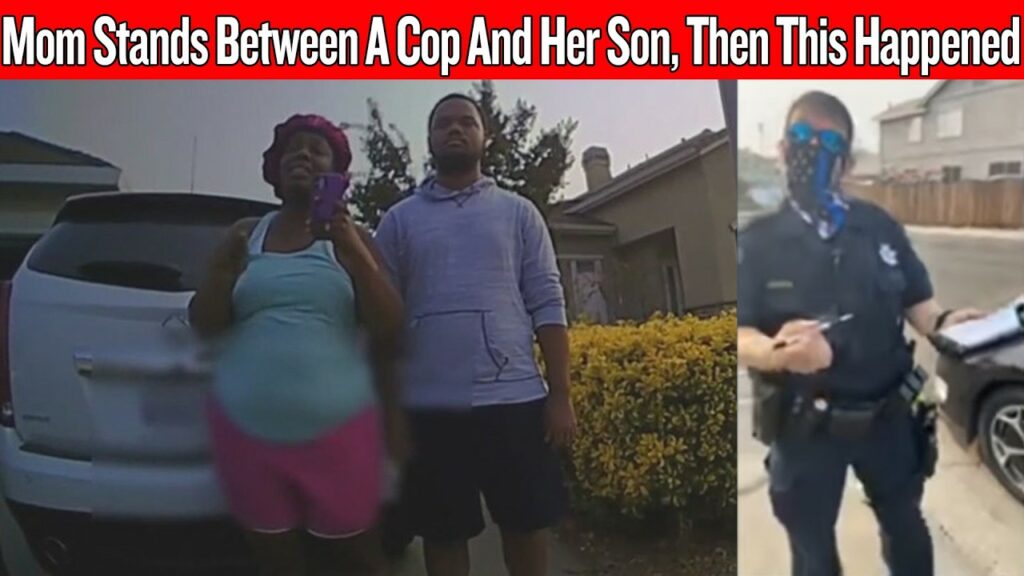
A video of a Black mother stepping into her own driveway to stand beside her 19-year-old son during a stop has been viewed more than 7.5 million times. It is circulating with the caption that the stop was illegal. Based on what the video shows, it probably was not. But that mother said one sentence that is the single most useful thing anyone has ever said on a sidewalk — and it is the reason this case is worth three minutes of your attention.
What Actually Happened in Those 3 Minutes
The woman is Stacey Harvey; the young man is her son, Tobias. The stop happened in California, not Texas, but every rule in it applies identically here, because the controlling authority is the Fourth Amendment. The clip drew over 7.5 million views in 9 days.
The stop, and the question that had nothing to do with it
Tobias, 19, rolled a stop sign and pulled into his own mother’s driveway. The officer took his license, registration, and insurance. She did not write a ticket. She called for backup. And while she waited, she started asking: “Are you on probation or parole?”
The mother comes out — and says the right thing
Harvey came outside, stood on her own property, started recording, and repeated one point: “You have his license. You have his registration and insurance. You were just looking at them. Run his name. Write the ticket.” She never touched anyone and never stepped between the officer and her son.
Then the line that tells you she understood the whole game: “Go ahead, give my son a ticket and we’ll deal with this in court.” Seven words. She was not trying to win on the curb. And police procedure experts who later reviewed the footage for ABC concluded the officer followed procedure start to finish. Understanding why is what protects you next time.
The Rule That Decides Every Stop: Rodriguez’s 2015 Stopwatch
In Rodriguez v. United States, 575 U.S. 348 (2015), the Supreme Court held that a traffic stop is a seizure under the Fourth Amendment justified by exactly one thing: the traffic violation. Once the tasks tied to that mission are done — or reasonably should have been done — the authority for the seizure ends.
The four tasks that make up the mission
- Addressing the violation — writing the warning or citation.
- Checking the driver’s license.
- Checking for outstanding warrants.
- Verifying registration and proof of insurance.
That is the list, and a routine Texas citation stop runs roughly 10 to 20 minutes when an officer works diligently.
There is no “only a few extra minutes” exception
Rodriguez shut the door on the argument every prosecutor tries: an officer earns no bonus time merely because the extension was brief. In Rodriguez itself, the dog sniff added about 7 to 8 minutes after the warning was issued. That was enough to make the seizure unconstitutional.

So when Harvey said “run his name, write the ticket” — standing in her own yard with no law degree — she described the Rodriguez mission almost perfectly. Every second past it needs new justification.
3 Reasons the Viral Caption Is Wrong Anyway
Knowing the weak points in your own argument is how you win on the strong ones.
Questions are free — if they don’t add time
Under Arizona v. Johnson, 555 U.S. 323 (2009), an officer may ask you anything — probation, parole, where you’re headed — with no independent suspicion, so long as the questions do not measurably extend the stop. The test is not whether the question was fair. It is whether it added seconds. Asked while walking back to the patrol car, the clock never moves.
The mission wasn’t finished, and backup is inside the rules
The officer had held the license about two minutes and had not run it yet — and the license and warrant check are the mission. Rodriguez also permits negligibly burdensome safety precautions, and under Pennsylvania v. Mimms, 434 U.S. 106 (1977) and Maryland v. Wilson, 519 U.S. 408 (1997) an officer may order the driver and every passenger out of the car with zero added justification.
The argument itself burns the clock — against you
This is what sinks most people. A meaningful share of those three minutes is the argument, and when you delay an officer from completing the mission you cannot later complain it took too long. Texas appellate courts apply no magic number of minutes: the question is whether the officer diligently pursued a means of investigation likely to confirm or dispel suspicion quickly. Diligence is the standard.
Were You Held Longer Than the Ticket Took?
If the search, the dog, or the questions came after the citation was done, that stop may be unconstitutional — and the evidence may be suppressible.
(346) 971-7333 — Free Case ReviewThe 3 Moments a Texas Stop Becomes Unconstitutional
The real question is never how long the stop lasted. It is what the officer did with that time, and whether you can prove it. In practice, a stop goes unconstitutional in one of three ways.
The citation is printed and you’re still sitting there
The ticket is written and handed over, and you are held while a K-9 unit drives in from across the county. That is Rodriguez on the facts. Everything after the mission is a new seizure needing its own reasonable suspicion.
Your license comes back and then “one more question”
They return your documents, say you’re free to go, then ask “mind if I ask you a couple questions?” Once your documents are back in your hand the detention is over, so everything after is legally a voluntary encounter and every answer counts as consent. Say “no thank you — am I free to go?” and drive.
“Just wait a few minutes for another unit”
No new facts, no new suspicion — only dead time after a stop they already finished. That is the line, and it has nothing to do with whether the officer was polite.

What Texas Law Makes You Hand Over — and the $2,000 Line
Your license, yes — your life story, no
Texas Transportation Code § 521.025 requires a driver to carry the license and display it on the demand of a peace officer; violating it is a misdemeanor with a fine up to $200 for a first offense. Hand over license, registration, and insurance immediately — every second arguing about paperwork burns your own clock. Then stop talking.
Detained is not arrested
Under Texas Penal Code § 38.02, refusing to give your name, address, or date of birth is an offense only after a lawful arrest — § 38.02(a). Merely detained, you owe nothing. The exception is § 38.02(b-1): a lawfully detained driver who fails to display a license and refuses to give name, license number, address, or date of birth commits a Class C misdemeanor, a fine up to $500. And § 38.02(b) makes giving a false name a Class B misdemeanor — up to 180 days in jail and a $2,000 fine. Never lie about your name.
You may record and you may talk — you may not block
Under Turner v. Driver (5th Cir. 2017) you have a clearly established First Amendment right to film police performing public duties — that video is the only reason we can analyze this stop at all. Penal Code § 38.15(d) makes it a defense that the interference was speech only. Physically inserting yourself is a Class B misdemeanor under § 38.15(b), with no such defense.
Never resist, even when you are completely right
Penal Code § 38.03(b) says it is no defense that the arrest or search was unlawful. Resisting is a Class A misdemeanor — up to one year in jail and a $4,000 fine — and it outlives the $200 ticket you were arguing about. Take the citation, let them put the cuffs on if it comes to that, say “I want to talk to my lawyer,” and stop.
The Script for the First 60 Seconds
Learn this now, because you will not think clearly when the lights come on.
- Record, and say the time out loud. “It is 9:14 a.m., I’m southbound on I-45.” You just made a timestamp — and the officer’s dashcam clock is subpoenable too.
- Hand over license, registration, insurance immediately. § 521.025 requires it.
- Then stop. “Officer, I’m not going to answer any more questions.”
- Ask once, calmly: “Am I free to go?” Then again every few minutes. It forces the officer to state on video whether you’re detained and builds the timeline your lawyer needs.
- Refuse consent to search, every time. Consent launders an illegal search; refusal preserves the challenge.
- Never physically resist.
The remedy comes later, and that is the whole point of Rodriguez. Held past the mission and they found something? That evidence gets suppressed. Held past the mission and they found nothing? That is a civil rights claim. Either way the win happens in a courtroom — exactly what Harvey meant by “we’ll deal with this in court.”
If you were detained past the point the ticket was finished, searched after the citation was written, or had a dog walked around your car after being told you were free to leave, that stop may have been unconstitutional. BJ Kemp handles these cases in Houston and the surrounding counties, and the first call is free. If you were the passenger rather than the driver, the rules differ — see your rights as a passenger during a Texas traffic stop. And if you plan to record, read the one trap in the right to film police in Texas.
Frequently Asked Questions
How long can a traffic stop legally last in Texas?
There is no fixed number of minutes. Under Rodriguez v. United States, 575 U.S. 348 (2015), the stop may last only as long as it reasonably takes to complete the mission: addressing the violation, checking the license, checking for warrants, and verifying registration and insurance. A routine Texas citation stop typically runs 10 to 20 minutes. Texas appellate courts apply a diligence standard rather than a stopwatch.
Can police ask if I am on probation or parole during a Texas traffic stop?
Yes. Under Arizona v. Johnson, 555 U.S. 323 (2009), officers may ask questions unrelated to the stop without any independent suspicion, so long as the questions do not measurably extend the stop’s duration. You are not required to answer them. Only your name, address, and date of birth are ever compelled, and only after a lawful arrest under Penal Code § 38.02(a).
Do I have to give my name at a Texas traffic stop if I am not under arrest?
Generally no. Texas Penal Code § 38.02(a) only criminalizes refusing to identify after a lawful arrest. The exception is § 38.02(b-1): a driver lawfully detained who fails to display a license and then refuses to give a name, license number, address, or date of birth commits a Class C misdemeanor, a fine up to $500. Giving a false name is a Class B misdemeanor punishable by up to 180 days in jail and a $2,000 fine.
Is a K-9 sniff after the ticket is written legal in Texas?
No, not without separate reasonable suspicion. Rodriguez held exactly this: once the warning or citation is complete, extending the stop for a dog sniff is an unconstitutional seizure. In Rodriguez itself the extension was only about 7 to 8 minutes, and the Court held that an officer earns no bonus time merely because the delay was brief.
Can I get out of the car or stand nearby while a family member is stopped?
You may record and you may speak. Texas Penal Code § 38.15(d) provides a defense when the alleged interference consisted of speech only. But physically placing yourself between an officer and the person being detained is interference with public duties under § 38.15(b), a Class B misdemeanor carrying up to 180 days in jail and a $2,000 fine. Keep your distance and keep recording.
Sources & Further Reading
- Rodriguez v. United States, 575 U.S. 348 (2015)
- Arizona v. Johnson, 555 U.S. 323 (2009)
- Pennsylvania v. Mimms, 434 U.S. 106 (1977)
- Turner v. Driver, U.S. Court of Appeals for the Fifth Circuit (2017)
- Texas Penal Code Chapter 38 — Obstructing Governmental Operation
- Texas Transportation Code § 521.025 — License to Be Carried and Exhibited on Demand

Your Houston Criminal Defense and Civil Rights Attorney
BJ Kemp
Texas State Bar #24116608 · Texas Legal Giants · Houston, TX
Most traffic stop cases are won on the timeline, not on the argument at the curb. BJ Kemp pulls the dashcam and body-worn footage, builds the minute-by-minute Rodriguez record, and moves to suppress everything the State found after the citation was done. Licensed in Texas and Michigan.
(346) 971–7333 — Free Case Review