

A small estate affidavit in Texas lets heirs collect a deceased person’s assets without going through a full probate proceeding — potentially saving families months of court time and thousands of dollars in legal fees. Under Texas Estates Code § 205.001, this simplified procedure is available when the estate’s total non-exempt assets are $75,000 or less, at least 30 days have passed since death, and no executor or administrator has been appointed.
Texas Estates Code § 205.001 — 5 Requirements You Must Meet
Texas law sets out five conditions that must all be satisfied before a small estate affidavit can be used. Failing to meet even one will cause the probate court to reject the filing:
- Intestacy — the decedent must have died without a valid will (intestate). If a will exists, the estate typically must go through the regular probate process unless the will itself expressly authorizes the small estate affidavit procedure
- 30-day waiting period — Texas Estates Code § 205.001(b) requires that at least 30 days have elapsed since the date of death before the affidavit may be filed; courts will not accept earlier filings
- $75,000 asset cap — the total value of all probate assets (excluding the homestead and property exempt under Tex. Prop. Code § 42.001) must not exceed $75,000
- No pending or granted administration — no application for appointment of a personal representative (executor or administrator) may be pending or previously granted in any Texas court for this estate
- All distributees must sign — every person entitled to inherit under Texas intestacy law must sign the affidavit; one heir cannot act alone
Meeting all five requirements does not guarantee the court or a financial institution will accept the affidavit — some asset holders require additional documentation or refuse to honor the procedure. An estate planning attorney can identify these obstacles before you file.
The $75,000 Asset Cap — What Counts and What Texas Law Excludes
Understanding which assets count toward the $75,000 limit is critical, because many families overestimate the estate’s probate value and unnecessarily pursue full probate. Texas law excludes several significant categories:
- The homestead — the decedent’s primary residence is excluded from the asset cap regardless of its value, provided a surviving spouse or minor child continues to reside there
- Exempt personal property — under Tex. Prop. Code § 42.001, up to $50,000 (per person) of clothing, furniture, vehicles, tools, firearms, and similar personal property is exempt from probate creditor claims and does not count toward the cap
- Beneficiary-designated accounts — life insurance policies, IRAs, 401(k)s, and bank accounts with a valid payable-on-death (POD) or transfer-on-death (TOD) designation pass entirely outside of probate and are not counted
- Joint tenancy and community property survivorship agreements — assets titled in joint tenancy with right of survivorship automatically pass to the surviving owner without probate
What does count toward the $75,000 cap: bank accounts without a POD designation, investment accounts without a TOD, vehicles titled solely in the decedent’s name, and personal property above the exempt threshold. A careful asset inventory is essential before filing.
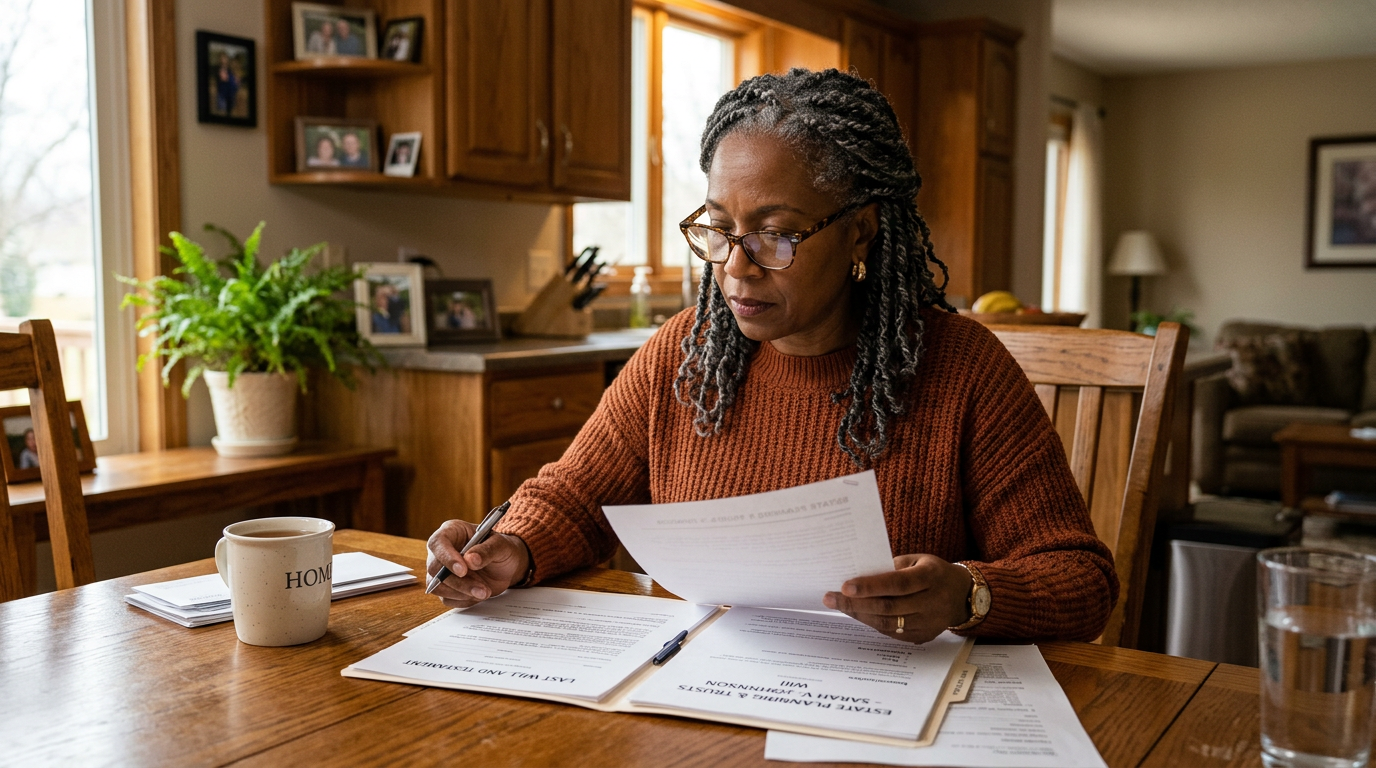
How to File a Small Estate Affidavit in Harris County — 5 Steps
Harris County has five probate courts (Courts 1 through 5), all located at 201 Caroline Street in downtown Houston. The small estate affidavit process in Harris County follows these steps:
- Step 1 — Gather documentation: Obtain the certified death certificate, a complete inventory of the decedent’s assets and debts, and proof of heirship (birth certificates establishing family relationships, marriage records, or prior court findings of heirship)
- Step 2 — Prepare and execute the affidavit: The affidavit must identify all heirs and their shares under Texas intestacy law, list all estate assets and their values, confirm no will exists, and be signed by all distributees and at least 2 disinterested witnesses — then notarized
- Step 3 — File with the probate court: File in the probate court of the county where the decedent was domiciled at the time of death. Harris County filing fees typically range from $150 to $250
- Step 4 — Obtain court approval: A judge reviews the affidavit for compliance. If approved, certified copies are issued — typically within 1 to 3 weeks of filing in Harris County
- Step 5 — Present to asset holders: Certified copies are presented to banks, title companies, credit unions, and the Texas Department of Motor Vehicles (for vehicle title transfers) to claim the decedent’s assets
Questions about navigating the Harris County probate court system? Our Houston estate planning attorneys guide families through every step of the process.
Not Sure If a Small Estate Affidavit Works for Your Family? Call BJ Kemp for a Free Consultation.
BJ Kemp fights for injury victims and families across Houston — free case review, no fee unless you win.
(346) 971–7333 — Free Case ReviewThe 30-Day Wait — And When the Court Still Requires Full Probate
Even when all five statutory requirements are met, courts may reject a small estate affidavit or require full probate in certain circumstances. Families should be aware of three common situations where the affidavit will not be sufficient:
- A distributee is a minor or legally incapacitated adult — if any heir lacks legal capacity, the court cannot approve a simple affidavit; a guardian ad litem may be required, and the court must independently protect that person’s interests through a formal probate proceeding
- Significant outstanding debts — the small estate affidavit does not formally resolve creditor claims the way a full probate administration does; creditors can still pursue heirs who receive assets under an affidavit, and heirs can be held personally liable for estate debts up to the value of assets received
- A third party refuses to honor the affidavit — some banks, title insurance companies, and brokerage firms have internal policies requiring court-issued letters testamentary or letters of administration before releasing assets; even a validly filed and approved affidavit may be refused by these institutions
3 Situations Where a Small Estate Affidavit Will Not Work in Texas
Beyond the situations where courts require full probate, certain asset types make the small estate affidavit procedure practically ineffective:
- Real estate other than the homestead — title insurance companies almost universally refuse to insure title transferred via a small estate affidavit alone; any real property other than the qualifying homestead typically requires a muniment of title proceeding, a full independent administration, or a heirship proceeding under Tex. Est. Code § 202.001 to pass clear title to buyers
- Estates with active disputes among heirs — if distributees disagree about asset values, heir status, or distribution shares, a court must resolve those disputes through a formal proceeding; the affidavit procedure requires unanimous agreement among all distributees
- Out-of-state assets — a Texas small estate affidavit has no legal effect on property located in another state; real estate in Louisiana, Oklahoma, or any other state requires ancillary probate in that state under its own laws
When the small estate affidavit is not available, Texas offers other streamlined alternatives. A muniment of title under Tex. Est. Code § 257.001 can pass real property through probate court without the full appointment of an administrator, often in 4 to 6 weeks. An independent administration gives an executor broad powers to settle the estate with minimal court supervision. BJ Kemp evaluates each family’s situation to recommend the fastest and lowest-cost path to clearing title and distributing assets.
Getting the Affidavit Right the First Time — Common Errors That Cause Rejections
A rejected small estate affidavit wastes filing fees, delays asset distribution by weeks or months, and sometimes pushes families into a full probate they could have avoided. The most common errors that lead to rejections in Harris County include:
- Incorrect asset valuation — listing the gross value of assets without deducting outstanding debts, or omitting assets because they seemed unimportant, leads to an inaccurate and legally defective affidavit
- Missing heir signatures — forgetting to include a distant relative, a child from a prior relationship, or a half-sibling who shares heirship rights under Texas intestacy law will invalidate the filing
- Filing in the wrong county — the affidavit must be filed in the county where the decedent was legally domiciled, not simply where they owned property or died; errors in jurisdiction result in automatic rejection
- Improper witness selection — witnesses must be “disinterested” (not heirs or creditors of the estate); using a family member who also stands to inherit will disqualify their testimony and potentially void the affidavit
BJ Kemp reviews every small estate situation before filing to confirm the procedure will succeed — or identifies when a muniment of title, independent administration, or heirship proceeding is the smarter and faster path for your family.
Frequently Asked Questions
Under Texas Estates Code § 205.001, the total value of all probate assets — excluding the homestead, exempt personal property under Tex. Prop. Code § 42.001 (up to $50,000 per person), and assets with named beneficiaries — must not exceed $75,000. Assets that pass by beneficiary designation (life insurance, IRAs, POD bank accounts) do not count toward the cap. If your probate assets exceed $75,000, you must use full probate, a muniment of title, or another authorized procedure.
You must wait at least 30 days after the date of death before filing. Once filed in Harris County, court review typically takes 1 to 3 weeks. After the court approves the affidavit and issues certified copies, banks and other institutions usually process asset transfers within 1 to 4 weeks of receiving the certified copy. Total timeline from death to asset distribution is commonly 6 to 10 weeks when the affidavit is properly prepared and all requirements are met.
Generally, no. Texas Estates Code § 205.001 applies to intestate decedents — those who died without a valid will. If a will exists, the estate must typically go through probate, either as a muniment of title (if the only asset is real property) or a full independent administration. A narrow exception exists if the will expressly authorizes use of the small estate affidavit procedure, but this is uncommon. A court cannot approve a small estate affidavit if a valid will has been identified.
No. A small estate affidavit does not formally discharge the decedent’s debts or protect heirs from creditor claims the way a full probate administration does. Under Texas law, heirs who receive estate property via a small estate affidavit can be held personally liable for the decedent’s debts up to the value of the property they received. If the estate has significant creditors — medical bills, mortgage deficiencies, or tax debts — a formal administration is often the safer choice because it provides a structured creditor claims process with a defined deadline.
Usually not for non-homestead real property. While Texas Estates Code § 205.001 does not expressly prohibit using a small estate affidavit for real estate, title insurance companies in Texas routinely refuse to insure title transferred by affidavit alone. Without title insurance, buyers cannot obtain mortgage financing and sellers cannot close. For any real property that the heir intends to sell or refinance, a muniment of title under Tex. Est. Code § 257.001 or a full probate is the practical requirement — even if the affidavit is technically valid.
Sources & Further Reading

Houston Estate Planning & Probate Attorney
BJ Kemp
Texas State Bar #24116608 · Texas Legal Giants · Houston, TX
BJ Kemp helps Houston-area families navigate the Texas probate system efficiently — whether that means a small estate affidavit, a muniment of title, or a full independent administration. He knows which Harris County courts move fastest and which asset holders require additional steps, so families can collect what they are owed without unnecessary delay or cost.
(346) 971–7333 — Free Case Review