

Harris County operates 5 dedicated statutory probate courts — more than any other county in Texas — giving Houston families specialized judges who handle nothing but probate, guardianship, and mental health matters. Knowing which court handles your case, where to file, and what deadlines apply can make the difference between a smooth estate administration and costly delays.
Overview: 5 Harris County Statutory Probate Courts Authorized Under Tex. Est. Code § 1022.001
Texas Estates Code § 1022.001 authorizes Harris County to maintain statutory probate courts with exclusive jurisdiction over probate matters. All 5 courts are located in the Harris County Civil Courthouse at 201 Caroline Street, Houston, TX 77002.
- Probate Court No. 1 — Suite 800; handles wills, dependent and independent administrations, small estates, and muniment of title proceedings.
- Probate Court No. 2 — Suite 680; handles probate matters and mental health commitments under the Texas Health & Safety Code.
- Probate Court No. 3 — Suite 330; handles probate, guardianship for adults and minors, and protective orders.
- Probate Court No. 4 — Suite 920; shares probate jurisdiction and handles a high volume of heirship determination proceedings.
- Probate Court No. 5 — Suite 1260; the newest court, established to address Harris County’s growing caseload, handling all standard probate matter types.
- Jurisdiction is concurrent — if a case involves personal injury claims by the estate, the probate court has jurisdiction under § 1022.004 to hear the full matter.
Cases are assigned randomly among the 5 courts at filing, so you do not choose your judge. An attorney familiar with all 5 courts’ procedural preferences can navigate each court efficiently.
What Each Court Handles — Exclusive vs. Concurrent Jurisdiction Under § 1022.006
The 5 Harris County probate courts hold exclusive jurisdiction over most estate and guardianship matters, meaning the District Courts cannot hear them. Key jurisdictional rules include:
- Independent administration — the most common form of Texas probate; the executor acts without ongoing court supervision, reducing legal fees and time significantly.
- Dependent administration — requires court approval for most executor actions; used when the will requires it or when beneficiaries cannot agree.
- Guardianship of the person and estate — for incapacitated adults; the probate court appoints a guardian and retains oversight for the life of the ward.
- Determination of heirship — required when someone dies without a will and the heirs must be formally identified by a court-appointed attorney ad litem.
- Mental health commitment proceedings — Courts 1 and 2 handle emergency mental health detention orders under Tex. Health & Safety Code § 574.001.
- Trust construction matters — disputes over the meaning or administration of a trust that arise after a death can be brought in the probate court.
Harris County Probate Filing Fees — $375 to $1,200 Depending on Case Type in 2024
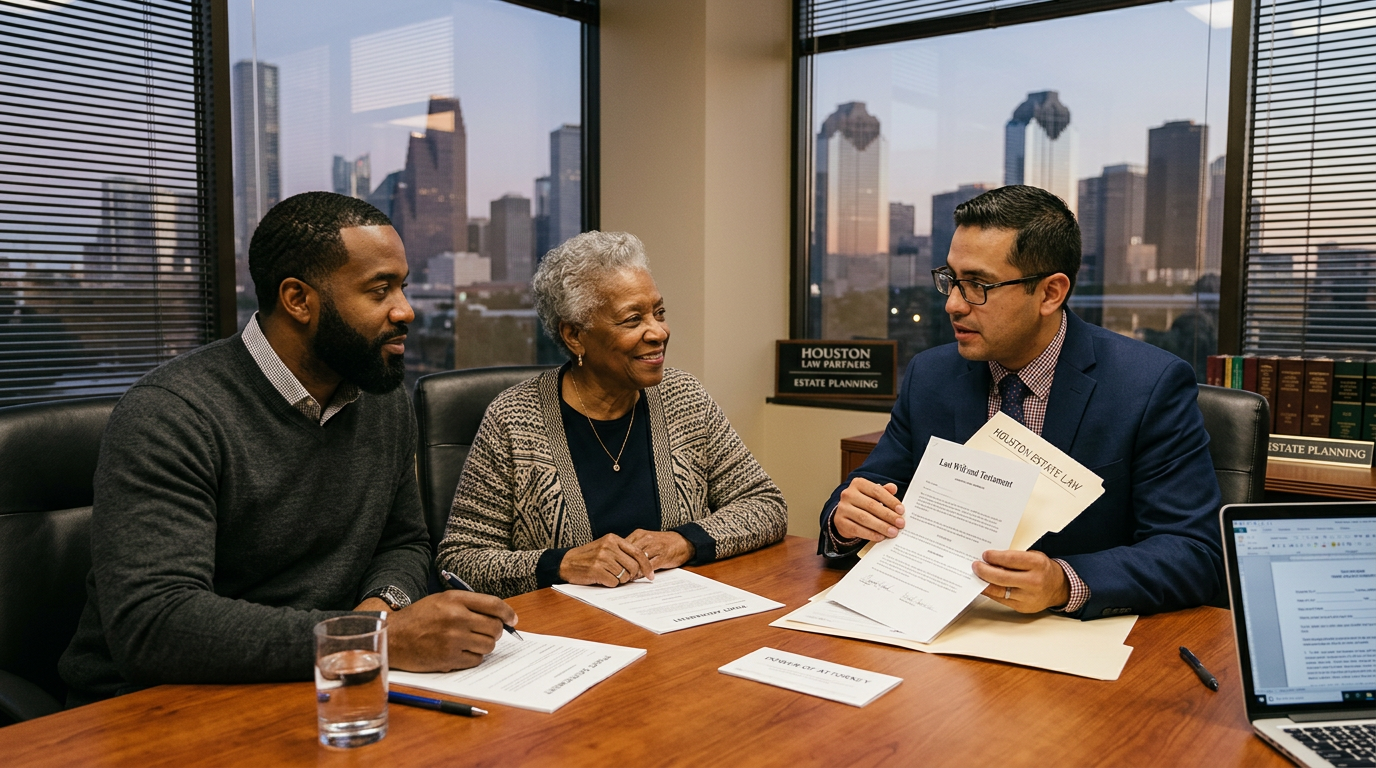
Filing fees in Harris County probate courts vary by case type and estate size. These are the standard fee ranges as of 2024:
- Application to probate a will — approximately $375–$450 for the initial filing fee, plus citation publication costs of $75–$200.
- Independent administration application — typically $375–$500 total at filing, including the basic filing fee and service fees.
- Dependent administration — base fees similar to independent, but ongoing costs accumulate with each court appearance and inventory approval.
- Guardianship application — initial filing fees range from $450–$600; annual accountings add $200–$400 per year throughout the guardianship.
- Determination of heirship — $375–$500 in filing fees plus the attorney ad litem fee set by the court, typically $500–$1,500.
- Muniment of title — the simplest and least expensive option at around $200–$350 when no administration is needed; see our Houston estate planning page for more probate-avoidance strategies.
Note: Fee schedules are set by the Harris County District Clerk and subject to change. Always verify current fees at the time of filing.
Navigating Harris County Probate Court? Get Guidance From an Experienced Houston Attorney.
BJ Kemp fights for injury victims and families across Houston — free case review, no fee unless you win.
(346) 971–7333 — Free Case ReviewCritical Deadlines — 4-Year Will Probate Limit Under Tex. Est. Code § 256.003
Missing a deadline in Harris County probate can permanently foreclose your options. The most important deadlines include:
- 4 years to probate a will — under Tex. Est. Code § 256.003, a will must be offered for probate within 4 years of the decedent’s death or it may only be admitted as a muniment of title.
- 90 days to file an inventory — after letters testamentary are issued, the executor must file an inventory, appraisement, and list of claims within 90 days under § 309.051, or seek an extension.
- 30 days to give notice to creditors — after qualifying as executor, you must notify known creditors within 30 days under § 308.054.
- 4 months for creditors to file claims — unsecured creditors have 4 months from the date of first publication of the notice to present claims under § 355.051.
- No statute of limitations on heirship — technically there is no hard deadline to determine heirship in Texas, but title companies will require it before insuring a sale of inherited real property.
- 2 years for will contests — a will that has been admitted to probate may be contested within 2 years of the order of probate under § 256.204.
How an Attorney Navigates All 5 Harris County Probate Courts
Each of the 5 Harris County probate judges has distinct preferences for how cases are presented, how contested matters are handled, and what documentation they expect. An experienced Houston estate attorney brings practical advantages that go beyond knowing the law:
- Electronic filing proficiency — all Harris County probate filings go through the eFiling system (eFileTexas.gov), which requires familiarity with document formatting and accepted file types.
- Relationship with court coordinators — scheduling hearings efficiently requires working knowledge of each court’s docket and coordinator preferences.
- Uncontested hearing efficiency — most simple probate hearings last 10–15 minutes; an attorney can often complete a full independent administration in a single hearing.
- Contested matter experience — will contests, guardianship disputes, and creditor claim objections require adversarial skills that a probate attorney develops over years of Harris County practice.
- Coordinating with title companies — selling real property during administration requires coordination between the probate court order and title company requirements that an experienced attorney navigates routinely.
For families managing an estate that also involves injury claims or wrongful death, our team handles both sides — visit our Houston wrongful death lawyer page to learn how these claims intersect with probate.
Frequently Asked Questions
After filing, the Harris County District Clerk randomly assigns your case to one of the 5 probate courts. You can look up your case number and assigned court on the Harris County District Clerk’s online case search at hcdistrictclerk.com. Cases are identified by cause number, and the last digit often indicates the court.
An uncontested independent administration in Harris County typically takes 6–12 months from filing to closing if the estate has no disputes, real estate sales, or complex assets. Dependent administrations and guardianships take longer — often 1–3 years. A simple muniment of title can sometimes be completed in 6–10 weeks.
Texas allows a personal representative to represent themselves (pro se) in an independent administration if they are the sole beneficiary. However, Tex. Est. Code § 401.003 generally requires an attorney to represent an estate in contested matters. In practice, the Harris County probate courts strongly encourage attorney representation even in uncontested cases, and filing errors often cause significant delays.
A muniment of title (Tex. Est. Code § 257.001) admits the will to record to pass title to real property without appointing an executor or opening a full administration. It is available only when there are no unpaid debts (other than real property liens) and no need to administer other assets. It is faster and less expensive than a full probate, often resolving in 6–10 weeks.
When a Harris County resident dies intestate (without a will), the estate is distributed according to the Texas laws of intestate succession under Tex. Est. Code § 201.001 et seq. The probate court opens a determination of heirship proceeding, appoints an attorney ad litem to investigate the family tree, and issues a judgment identifying the legal heirs. An administrator — not an executor — is then appointed to manage the estate.
Sources & Further Reading

Houston Probate & Estate Planning Attorney
BJ Kemp
Texas State Bar #24116608 · Texas Legal Giants · Houston, TX
BJ Kemp regularly guides Houston families through Harris County’s 5 probate courts, handling everything from straightforward independent administrations to contested will disputes and complex guardianship matters. If your family is facing the probate process after a loss, BJ can help you navigate it efficiently and with compassion — call today for a free consultation.
(346) 971–7333 — Free Case Review