
Every year, hundreds of people are killed and thousands seriously injured in commercial truck accidents across Texas. On Houston’s congested freeways — I‑10, I‑45, I‑69, the Beltway, the 610 Loop — 18‑wheelers, tanker trucks, and delivery vehicles share the road with millions of passenger cars every single day.
When a fully loaded semi‑truck weighing 80,000 pounds collides with a passenger vehicle weighing 3,500 pounds, the results are catastrophic. Traumatic brain injuries. Spinal cord damage. Amputations. Wrongful death. The physical, financial, and emotional toll can last a lifetime — and the legal battle is nothing like a standard car accident claim.
Texas Legal Giants handles truck accident cases throughout Greater Houston. We know federal trucking law, how to preserve critical evidence, and how to fight the large commercial insurance carriers that defend trucking companies.
Why are truck accident cases more complex than regular car accidents in Texas?
Truck accidents involve federal FMCSA regulations that don’t apply to car accidents, multiple potentially liable parties (driver, carrier, owner, loader, maintenance company), specialized time-sensitive evidence (ECM/black box data, ELD logs, driver qualification files), and insurance policies with limits 10–100x higher than standard auto policies. Trucking companies deploy accident response teams within hours of a crash to protect their interests. Victims need an attorney who moves just as fast.
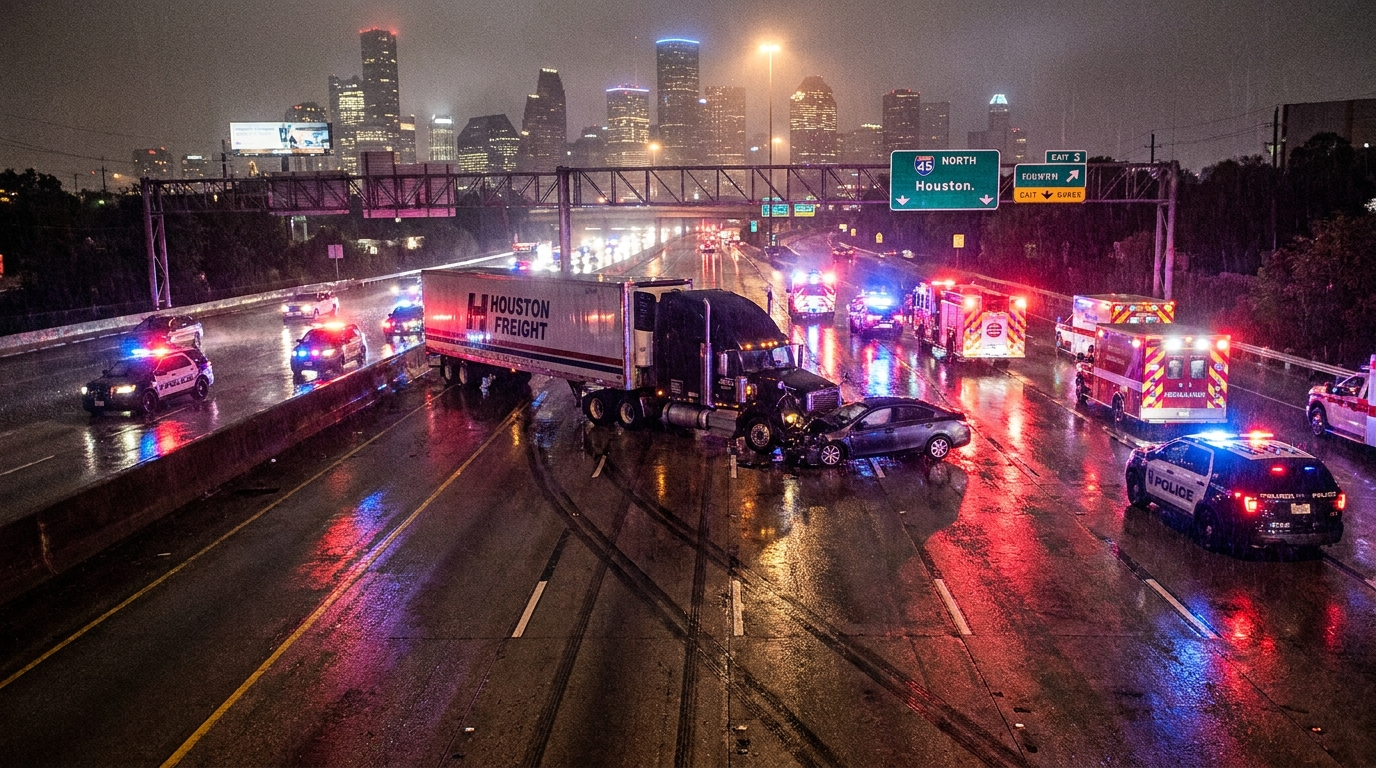
Who Can Be Held Liable in a Houston Truck Accident?
Unlike car accidents, truck crashes routinely involve multiple liable parties — each with their own insurance and legal team.
The Truck Driver
Hours‑of‑service violations, distracted driving, impairment, speeding, improper lane changes. Driver fatigue alone accounts for a significant percentage of all fatal truck crashes.
The Trucking Company
Negligent hiring, inadequate training, pressure to skip rest periods, ignoring known safety violations. Companies are directly liable under respondeat superior for their drivers’ acts.
The Vehicle Owner
When the truck is leased or owned separately from the operator, the owner carries independent liability for maintenance failures and for entrusting the vehicle to an unqualified driver.
Cargo Shipper / Loader
Improperly loaded or unsecured cargo causes rollovers and jackknife accidents. Shippers who violate FMCSA cargo securement rules share liability for the resulting crash.
Maintenance Company
Brake failures, tire blowouts, and steering defects are often preventable. Third‑party maintenance providers that performed faulty repairs share liability for resulting accidents.
Truck Manufacturer
Defective ABS systems, steering components, coupling systems, or tires can cause catastrophic accidents regardless of driver conduct. Product liability runs parallel to negligence claims.

Critical Evidence We Pursue Immediately
Time-sensitive evidence is the backbone of every truck accident case. We move fast to preserve it before it’s gone.
Electronic Control Module (Black Box)
Records vehicle speed at impact, brake application timing, throttle position, cruise control status, and hard braking events. Stored in a rolling window — can be overwritten when the truck returns to service.
Electronic Logging Device (ELD) Records
Since 2017, most commercial trucks must use ELDs that automatically record hours of service. These create an objective, tamper-resistant record of whether the driver violated federal rest requirements before your crash.
Driver Qualification Files
Trucking companies must retain files covering driving records, license verification, medical certifications, and employment history. Prior violations or failed drug tests the company ignored are powerful evidence of negligent hiring.
Drug & Alcohol Test Results
FMCSA mandates post‑accident testing when there is a fatality, serious injury, or citation. If a driver was not tested as required, or results were delayed or suppressed, that failure itself is evidence of wrongdoing.
Dashcam & Surveillance Footage
Many trucks carry forward‑ or cab‑facing cameras. Business surveillance and TxDOT traffic cameras along Houston freeways can capture the crash — but footage is often overwritten within 24‑72 hours without a preservation demand.
Maintenance & Inspection Records
Federal law requires pre‑trip inspections before every run and regular scheduled maintenance. Records showing known defects that were ignored — bad brakes, worn tires — create direct liability for the company and maintenance provider.
Types of Truck Crashes We Handle
Jackknife Accidents
The trailer swings perpendicular to the cab, blocking multiple lanes. Often fatal for any vehicle in the path.
Rollover Accidents
Caused by excessive speed, improper loading, or sudden maneuvers. Deadly for any vehicle below the trailer.
Underride Accidents
A smaller vehicle slides under the trailer — often fatal even at low speeds. Guards are frequently deficient or missing.
Rear-End Collisions
A loaded truck at highway speed requires up to 400 feet to stop — following too close is catastrophic.
Wide-Turn Accidents
Right-turn accidents trap cyclists or cars in the truck’s turning radius. A leading cause of cyclist fatalities.
Cargo Spill Accidents
Unsecured loads falling onto the roadway create multi-vehicle accidents. The shipper and loader share liability.
Tire Blowout Accidents
Tread separation at highway speeds causes sudden loss of control. Preventable with proper maintenance — traceable to inspection records.
Brake Failure Accidents
Faulty or poorly maintained brakes are among the most dangerous defects on a commercial truck and frequently ignored on inspection records.
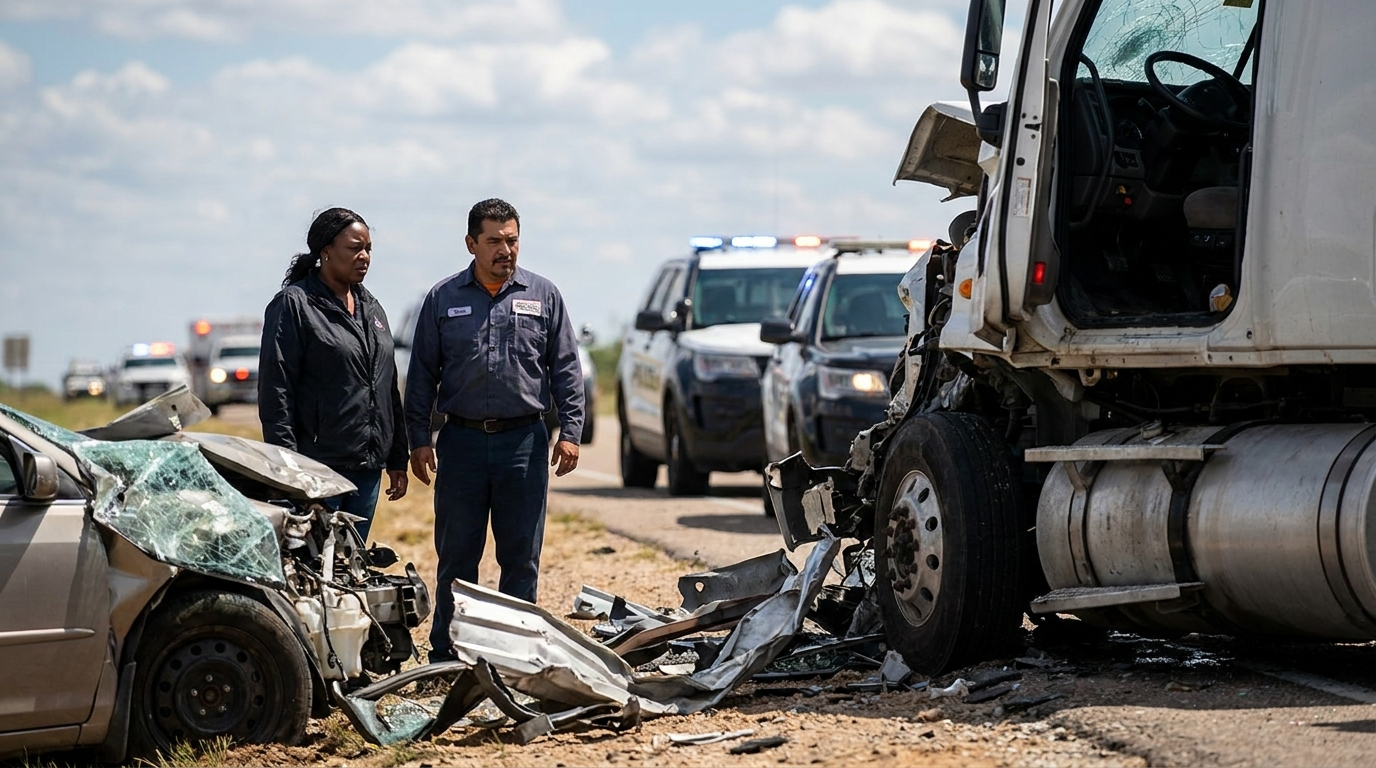
How much is a Houston truck accident case worth?
Truck accident cases routinely result in significantly higher settlements and verdicts than car accident cases because of higher insurance policy limits (federal minimum is $750,000; many carriers carry $1M–$5M), more severe injuries (the mass disparity between an 80,000-lb truck and a passenger car means catastrophic outcomes), and multiple liable defendants each with their own coverage. Cases involving spinal cord injuries, traumatic brain injuries, or fatalities regularly reach seven figures or higher in the Houston market.
Compensation Available to Truck Accident Victims
Economic Damages
- All past & future medical expenses
- Surgery, hospitalization, rehabilitation
- Home care & assistive devices
- Lost wages during recovery
- Reduced future earning capacity
- Vehicle & property damage
- Out-of-pocket accident expenses
Non-Economic Damages
- Physical pain & suffering
- Mental anguish
- Physical impairment
- Disfigurement
- Loss of enjoyment of life
- Loss of companionship
- PTSD & emotional distress
Punitive Damages
- Available when trucking company acted with gross negligence
- Applies when known safety violations were ignored
- When evidence was destroyed
- When disqualified driver was allowed to operate
- Separate from & in addition to compensatory damages
What to Do After a Truck Accident in Houston
Call 911 Immediately
A police report documents the accident and captures truck information. Make sure officers know a commercial truck is involved so the full accident report includes required data — DOT number, carrier name, and vehicle identification.
Get Medical Care the Same Day
Adrenaline masks serious injuries. Traumatic brain injuries, internal bleeding, and spinal damage may not be immediately obvious. A same‑day medical record creates the critical link between the crash and your injuries.
Document Everything at the Scene
Photograph all vehicles, the truck’s license plate and DOT number, cargo, road conditions, skid marks, and your injuries. Get the truck driver’s CDL number, the trucking company name, and the insurance carrier.
Do Not Talk to the Trucking Company’s Insurer
The commercial insurance carrier may contact you within hours. Do not give a recorded statement or sign anything. Their goal is to minimize your claim from the first conversation. Contact an attorney first.
Call Texas Legal Giants
The moment we are retained, we send a legal hold letter to the trucking company and their insurer — notifying them of their obligation to preserve all evidence and that destruction of any records may constitute spoliation.
What evidence disappears fastest after a Houston truck accident?
The ECM (electronic control module / black box) records speed, braking, throttle, and hours driven — but trucking companies can legally overwrite this data in as little as 30 days. ELD (electronic logging device) records showing hours-of-service violations, dashcam footage, and post-accident drug and alcohol test results are all time-critical. Driver qualification files, maintenance records, and cargo documentation can also be altered or destroyed if a legal hold isn’t issued immediately. Texas Legal Giants sends a spoliation letter within hours of being retained.
What Trucking Companies and Insurers Argue
Commercial carriers send their own legal team to the scene. Here is what they use against victims.
The Driver Was an Independent Contractor
Trucking companies frequently try to classify drivers as independent contractors to avoid respondeat superior liability. Texas courts look at actual control over the driver’s work — not just what the contract says. We investigate the full employment relationship to pierce this defense.
The Victim Contributed to the Accident
Insurers will study your driving behavior, lane position, speed, and any traffic violations to assign as much fault to you as possible. Every percentage point they push onto you reduces your recovery. We counter with accident reconstruction and black box data that shows what actually happened.
The Driver Was Hours-of-Service Compliant
If ELD records show the driver was within legal limits, insurers use this to argue fatigue wasn’t a factor. But ELD data can be manipulated, and legal hours-of-service compliance doesn’t mean the driver wasn’t fatigued. We look beyond the logs at the driver’s actual schedule and workload.
Your Injuries Pre-Existed the Crash
Any prior back or neck condition becomes leverage to argue the truck didn’t cause your injuries. Texas law allows recovery for aggravated pre-existing conditions — we work with your treating physicians to document exactly what the crash caused or significantly worsened.
The Early Settlement Offer Is Generous
Commercial insurers sometimes make quick offers that seem large but are a fraction of the full value — before you know the true extent of your injuries. Once you sign a release, you cannot return for more. Never accept a settlement from a trucking company’s insurer without attorney review.
Free Case Review — No Fee Unless We Win
Truck accident cases move fast. Evidence disappears. Call Texas Legal Giants now — we’ll get to work immediately.
(346) 971–7333 — Call NowFrequently Asked Questions
Related Practice Areas
Helpful Resources
- FMCSA Federal Motor Carrier Safety Regulations Full federal trucking regulations
- FMCSA Safety Measurement System (SMS) Look up a carrier’s safety record
- TxDOT CRIS — Request Your Texas Crash Report (CR-3) Official source, $6 fee
- Texas Civil Practice & Remedies Code §16.003 — Statute of Limitations Texas Legislature
- NHTSA FARS — Fatality Analysis Reporting System Federal crash fatality data

Your Houston Truck Accident Attorney
BJ Kemp
Texas State Bar #24116608 · Texas Legal Giants · Houston, TX
BJ Kemp fights for truck accident victims throughout Greater Houston. He knows federal trucking law, how to preserve critical evidence before it disappears, and how to take on the large commercial insurers that defend trucking companies. Big Commitment. Giant Results. You pay nothing unless we win.
(346) 971–7333 — Free Case Review